AI Video Personalization: Create Videos for Customers

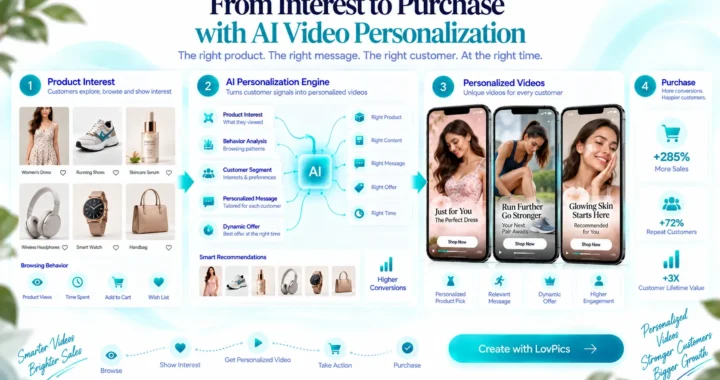
AI Video Personalization helps businesses create more relevant marketing experiences by adapting video content for different customers and audience segments. Not every customer responds to the same marketing message. A first-time visitor may need an introduction to a product, while a returning customer may already understand the brand and need a reason to purchase again. A high-value customer may respond better to premium products, while a price-sensitive customer may be more interested in an offer.
Traditional marketing often addresses these differences through separate campaigns, landing pages, email messages, or advertisements. Video personalization takes the concept further.
Instead of creating one generic video and showing it to everyone, businesses can adapt elements of the video based on audience characteristics, marketing objectives, product interests, language, location, or customer stage.
AI makes this approach more practical because businesses can create and adapt video variations without producing every version entirely from scratch. The result is a marketing workflow where the core creative idea remains consistent while the experience becomes more relevant to the viewer.
Why Video Personalization Matters for Modern Marketing
Personalization has become increasingly important because customers are exposed to enormous amounts of marketing content. A generic message can easily be ignored.
A message that reflects what a customer actually cares about has a better opportunity to capture attention.
Different Customers Have Different Needs
Consider an ecommerce fashion brand.
- A new customer might see: “Discover our latest collection.“
- A returning customer who previously purchased dresses might see: “New styles selected for you.“
- A customer interested in winter clothing could receive: “Explore our new winter collection.“
The brand remains the same. The campaign remains connected. But the message changes according to the audience.
Video Can Carry More Context Than Static Personalization
Personalization is often associated with names, emails, recommendations, or dynamic website content. Video adds another dimension.
Businesses can personalize:
- Product selection
- Voiceover
- Language
- Messaging
- Visual scenes
- Offers
- Customer benefits
- Calls to action
- Campaign themes
This creates more opportunities to make the content relevant.
Personalization Can Support Different Stages of the Customer Journey
A person discovering a brand for the first time needs a different message from an existing customer.
For example:
- Awareness: Introduce the brand.
- Consideration: Explain the product.
- Conversion: Highlight benefits and offers.
- Retention: Encourage another purchase.
- Loyalty: Promote exclusive products or experiences.
AI video personalization can support these different stages with tailored creative variations.
The Challenge of Creating Personalized Videos at Scale
Personalized video sounds simple until a business needs to create hundreds or thousands of variations.
Traditional Production Becomes Expensive
If a company wants ten different customer segments and each segment requires a separate video, traditional production can quickly become expensive.
Each version may require:
- Script changes
- Voiceover recording
- Editing
- Visual changes
- Review
- Rendering
- Distribution
The workload increases as the number of variations grows.
Multiple Audiences Require Multiple Messages
Different audiences may care about different benefits. A business cannot simply change one word and consider the video fully personalized. The creative may need to change at several levels.
Localization Adds Another Layer
International businesses may need different:
- Languages
- Voiceovers
- Cultural references
- Offers
- CTAs
- Product selections
This can make manual video personalization even more difficult.
Personalization Can Create Brand Inconsistency
When many versions are produced, businesses may accidentally create videos that look unrelated.
The challenge is therefore not only creating variations.
It is creating variations while maintaining a consistent brand identity.
What Is AI Video Personalization?
AI video personalization is the use of artificial intelligence to create or adapt video content for specific customer groups, audiences, or marketing situations.
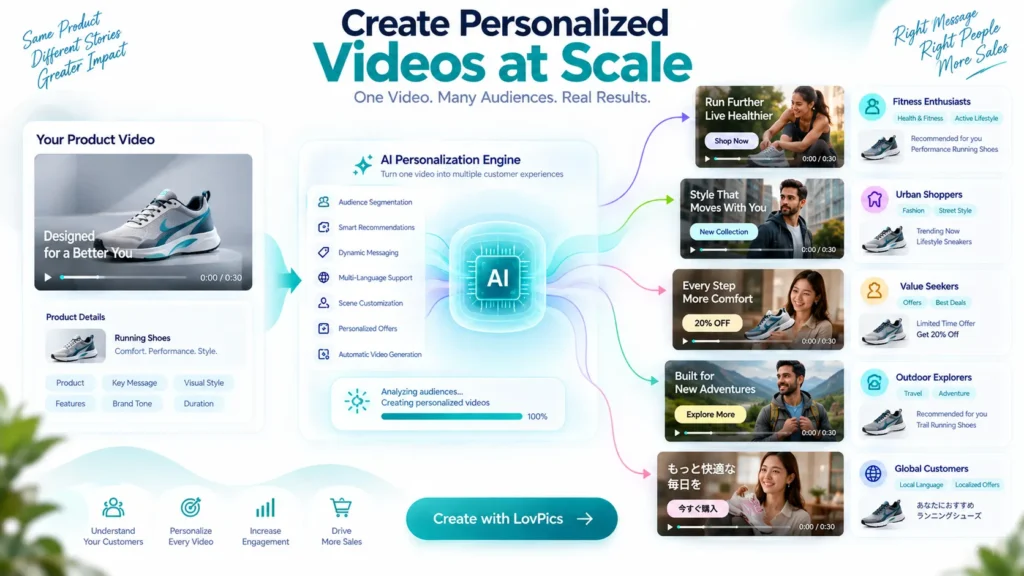
Instead of producing one fixed video, businesses can establish a core video concept and then generate variations based on predefined personalization criteria.
For example:
Core Video
“Discover our latest products.”
can become:
New Customer
“Discover what makes our collection different.”
Returning Customer
“Explore what’s new since your last purchase.”
Premium Customer
“Discover our latest premium collection.”
Regional Customer
“Explore our collection available in your region.”
The personalization can involve the content, visuals, voice, products, offers, or CTA.
Personalization Does Not Mean Every Video Must Be Completely Different
One of the most important principles is to avoid unnecessary complexity.
A business can keep common elements such as:
- Brand identity
- Product positioning
- Visual style
- Core campaign idea
- Intro or outro
- Brand voice
Then personalize selected elements.
This makes the workflow more scalable.
How AI Video Personalization Works
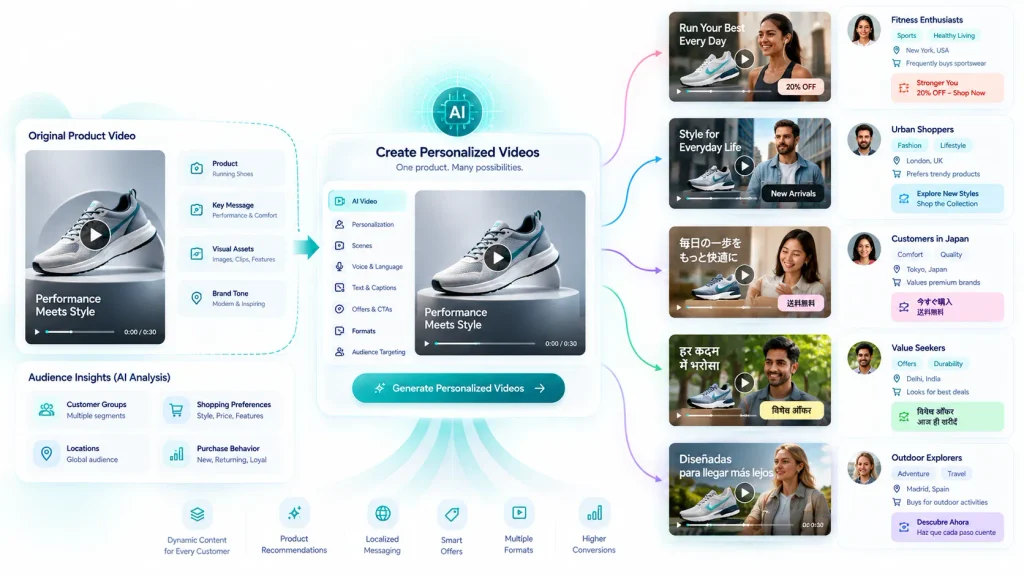
Identify the Customer Segments
Start by determining which groups actually require different messaging.
Possible segments include:
- New customers
- Returning customers
- High-value customers
- First-time buyers
- Product-category shoppers
- Geographic audiences
- Language groups
- Industry segments
- Customer lifecycle stages
Avoid creating segments simply because technology allows it. Each segment should have a meaningful marketing reason.
Define What Changes Between Segments
Next, determine which parts of the video should change.
For example:
| Video Element | Personalization Opportunity |
| Product | Recommended product |
| Script | Segment-specific message |
| Voiceover | Language or voice |
| Scene | Audience-relevant environment |
| Offer | Segment-specific promotion |
| CTA | Desired customer action |
| Text | Customer-specific messaging |
| Format | Platform or audience requirement |
This creates a personalization framework before production begins.
Create the Core Video Concept
Develop the central creative idea first.
For example: Problem → Product → Benefit → Proof → CTA
The structure can remain consistent across customer segments. Then specific sections can be adapted.
Generate Personalized Variations
AI can help produce variations based on the predefined rules.
For example, the same product campaign could have different versions for:
- New customers
- Existing customers
- Premium customers
- Regional audiences
- Different languages
The important principle is controlled variation.
Maintain Brand Consistency
Every personalized version should still look like it belongs to the same brand.
Use consistent:
- Brand colors
- Typography
- Visual language
- Product presentation
- Logo treatment
- Tone
- CTA style
Personalization should change the experience without weakening brand recognition.
Review Before Distribution
AI-generated variations should still go through quality control.
Check:
- Product accuracy
- Messaging
- Voiceover
- Visual consistency
- CTA
- Language
- Brand elements
- Customer relevance
Automation should increase production capacity, not remove quality control.
How Businesses Can Scale AI Video Personalization
Start With a Small Number of High-Value Segments
Businesses do not need hundreds of variations immediately.
Start with segments where personalization can have a clear commercial benefit.
For example:
- New Customers
- Returning Customers
- High-Value Customers
- Product Category A
- Product Category B
Once the workflow is validated, additional segments can be introduced.
Build Modular Video Templates
Instead of creating each video from scratch, businesses can build reusable structures.
For example: Intro → Product → Benefit → Personalized Message → CTA
The personalized section can change while the remaining structure stays consistent.
This makes production easier to manage.
Connect Product Data With Creative Workflows
Ecommerce businesses already have valuable information about their products.
This can include:
- Product category
- Price
- Features
- Availability
- Product images
- Product descriptions
These assets can support personalized video creation.
Create Multiple Versions From One Campaign
A campaign can become a collection of targeted assets.
For example:
Core Campaign
- New Customer Version
- Returning Customer Version
- Premium Customer Version
- Regional Version
- Product Interest Version
This provides greater creative coverage without requiring an entirely new campaign for every audience.
Scale Across Languages
Personalized video strategies can also connect with multilingual marketing.
A business can create audience-specific versions in:
- English
- Hindi
- Spanish
- Arabic
- French
- German
- Japanese
- Other target languages
This allows personalization and localization to work together.
Scale Across Marketing Channels
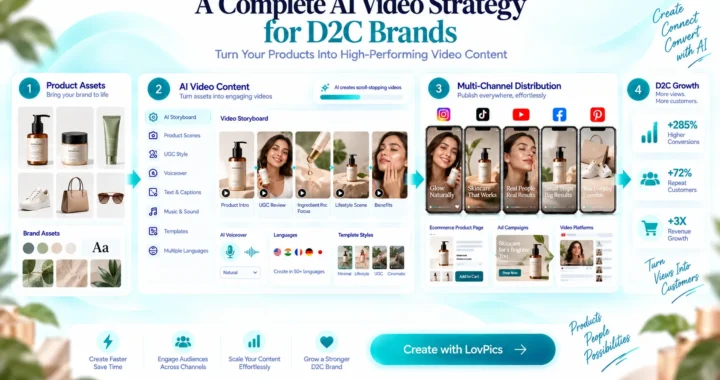
The same personalized concept can be adapted for:
- Social media
- Landing pages
- Ecommerce stores
- Paid advertising
- Sales outreach
- Product launches
The message remains connected while the format changes according to the channel.
Related LovPics AI Video Solutions
- AI Multilingual Videos : Create video variations for audiences speaking different languages.
- AI Video Translation: Adapt existing video messaging for different languages.
- AI Video Localization: Adapt videos for specific regional audiences and markets.
- AI Product Videos: Create product-focused videos that can serve as the foundation for personalized campaigns.
- AI Multilingual Marketing Videos: Develop marketing video content for audiences across multiple languages.
- AI Multilingual Reels: Create short-form personalized content for different audiences.
- AI Video Storyboarding: Plan different video variations before generating the final creative.
- AI Lip Sync: Support personalized or localized video experiences with synchronized speech.
- AI Reels: Turn personalized campaign concepts into short-form social video content.
- AI Social Media Ad Creatives: Extend personalized video concepts into targeted advertising campaigns.
Real-World Applications of AI Video Personalization
E-commerce Product Recommendations
An ecommerce brand can create different product videos based on customer interests. For example, customers who browse running shoes could receive content focused on running footwear, while customers interested in casual sneakers receive a different product presentation. The core brand identity remains consistent, but the product emphasis becomes more relevant.
Fashion Customer Segments
Fashion brands can personalize videos based on categories customers interact with. A customer interested in women’s ethnic wear could see a campaign centered around that collection. Another customer interested in formalwear could receive a different video highlighting office and occasion styles. This can make large catalogs easier to promote to specific audiences.
Beauty and Skincare Marketing
Beauty brands often have products designed for different routines and customer needs. Personalized videos can focus on different product categories, routines, or benefits. For example, a customer interested in skincare can receive educational content around a skincare routine, while another audience sees content focused on makeup products.
Customer Retention Campaigns
Existing customers already have a relationship with the brand. A personalized video can acknowledge that relationship through relevant product recommendations, new collections, complementary products, or loyalty-focused messaging. The goal is to make the communication feel more relevant than a generic advertisement.
New Customer Onboarding
Businesses can use personalized video content to introduce new customers to products, services, or features. For SaaS businesses, this could mean creating different onboarding videos based on the customer’s selected plan or use case.
Regional Marketing
A national or international brand may have customers with different regional preferences.
Personalized videos can adapt:
- Language
- Product emphasis
- Offers
- Cultural context
- CTA
- Local messaging
This can help regional campaigns feel more relevant.
B2B Marketing
Personalization is not limited to ecommerce.
B2B companies can create different videos for industries such as:
- Retail
- Healthcare
- Education
- Finance
- Manufacturing
- Technology
The same solution can be presented through different business problems and use cases.
Sales Outreach
Sales teams can use personalized videos to explain how a product or service relates to a specific prospect’s situation. Instead of a generic product presentation, the video can focus on the prospect’s industry, business challenge, or use case.
Product Launches
A new product can be promoted differently to existing customers, prospects, distributors, and high-value buyers. Each audience can receive messaging that reflects its relationship with the product and brand.
AI Video Personalization Across the LovPics Ecosystem
AI video personalization can become part of a larger creative workflow rather than functioning as a standalone capability.
A typical workflow could look like: Customer Segmentation → Product & Audience Selection → Video Storyboard → Core AI Video → Personalized Variations → Language Localization → Platform Adaptation → Campaign Distribution
This connects personalization with several areas of the LovPics ecosystem.
- A product image can become a product video.
- That video can become multiple campaign variations.
- Those variations can then be localized into different languages.
- The resulting content can be adapted into Reels, advertisements, and other marketing formats.
- This creates a more connected content production process.
Expand AI Video Personalization with LovPics
LovPics can help businesses move from one-size-fits-all video production toward a more flexible content workflow. The starting point can be a single campaign concept.
From there, businesses can develop variations based on:
- Customer segment
- Product interest
- Market
- Language
- Campaign objective
- Marketing channel
- Customer journey stage
For example:
One Product Campaign
can become:
- New Customer Video
- Returning Customer Video
- Premium Customer Video
- Regional Video
- Multilingual Video
- Social Media Version
- Advertising Version
The objective is not to create unnecessary versions.
The objective is to create the right version for the right audience when personalization can improve the customer experience or marketing outcome. By connecting AI video creation with product visuals, multilingual content, localization, social creatives, and reusable workflows, businesses can build a scalable personalized video strategy.
Common Mistakes Businesses Make
Personalizing Everything
Not every customer needs a completely different video. Creating too many variations can make the workflow unnecessarily complex.
Better approach: Identify the customer differences that actually affect the marketing message and personalize only those elements.
Using Customer Data Without a Clear Purpose
Personalization should have a marketing reason. Simply inserting customer information into a video does not automatically make it useful.
Better approach: Connect every personalization element to customer relevance or a clear business objective.
Changing the Brand Experience Too Much
Personalized videos can become inconsistent when every segment receives a completely different visual style.
Better approach: Keep the core brand identity consistent and personalize selected elements.
Creating Segments That Are Too Narrow
A business may try to create a different video for every small customer group. This can create more production complexity than business value.
Better approach: Begin with meaningful, commercially important segments.
Personalizing Only the Customer’s Name
Adding a name is a very limited form of personalization. A truly useful personalized video can change the product, benefit, message, offer, language, or CTA.
Better approach: Personalize the content around what the customer actually needs.
Ignoring the Customer Journey
A first-time visitor and a loyal customer should not necessarily receive the same message.
Better approach: Consider where the audience is in the buying journey when designing personalized videos.
Forgetting Quality Control
Creating many AI-generated versions increases the possibility of errors. A product detail, price, offer, voiceover, or CTA can be wrong in one variation.
Better approach: Establish automated checks and human review for important campaign assets.
Measuring Only Overall Video Performance
A personalized video strategy may have multiple audience segments. Looking only at total views can hide meaningful differences.
Better approach: Compare performance by segment, message, product, CTA, and campaign objective.
The Future of AI Video Personalization
AI video personalization is moving toward increasingly dynamic marketing experiences. Instead of producing a handful of predefined versions, businesses may be able to generate content that adapts more closely to individual customer contexts.
Future workflows could combine: Customer Signals + Product Data + AI Creative Generation + Real-Time Personalization
- A customer interested in a particular product category could receive a video emphasizing that category.
- A returning customer could see complementary products.
- A customer in another region could receive localized language and messaging.
- A business customer could receive industry-specific content.
- The technology will continue to make these variations easier to produce.
However, strategy will remain important.
The goal should not be to create the maximum number of personalized videos.
The goal should be to create more relevant customer experiences without creating an unmanageable production process.
Businesses that build structured personalization workflows now can be better positioned as AI-driven marketing becomes more dynamic.
Comparison Table
| Approach | Content Variations | Production Effort | Scalability | Personalization |
| One Generic Video | Very Low | Low | High | Low |
| Manually Produced Segmented Videos | Medium | High | Low | High |
| Template-Based Videos | Medium | Medium | High | Medium |
| AI Video Personalization | High | Lower at Scale | High | High |
| AI + Human Creative Workflow | High | Medium | High | Very High |
Decision Matrix
| Business Scenario | Generic Video | Segmented Videos | AI Personalization |
| Small audience | ✓ | ✓ | Optional |
| Large customer base | △ | ✓ | ✓ |
| Multiple product categories | △ | ✓ | ✓ |
| Multiple languages | △ | ✓ | ✓ |
| Frequent campaigns | △ | ✓ | ✓ |
| Large ecommerce catalog | △ | ✓ | ✓ |
| Highly targeted marketing | △ | ✓ | ✓ |
| Global marketing | △ | ✓ | ✓ |
Key: ✓ Recommended, △ May be suitable depending on the campaign.
Frequently Asked Questions
What is AI video personalization?
AI video personalization is the use of AI to create or adapt marketing videos for different customers, audience segments, markets, products, or marketing situations.
How is AI video personalization different from a normal marketing video?
A normal marketing video generally communicates the same message to everyone. Personalized video can adapt elements such as messaging, products, offers, language, visuals, or CTAs for different audiences.
Can AI create different videos for different customer segments?
Yes. Businesses can define audience segments and create variations of a core video based on the needs and characteristics of each segment.
What can be personalized in an AI video?
Depending on the workflow, businesses can personalize products, messaging, voiceovers, languages, scenes, offers, on-screen text, and calls to action.
Does every customer need a completely different video?
No. In many cases, businesses can keep the core creative structure and personalize only the elements that matter to the audience.
Is AI video personalization useful for ecommerce?
Yes. Ecommerce businesses can personalize product recommendations, benefits, offers, campaigns, and messaging for different customer groups.
Can AI personalized videos be created in multiple languages?
Yes. Personalization can be combined with multilingual video creation, translation, dubbing, and localization.
Can small businesses use AI video personalization?
Yes. Small businesses can begin with a few meaningful customer segments rather than attempting large-scale individual personalization.
How can businesses scale personalized video production?
Businesses can use reusable templates, modular video structures, standardized brand guidelines, customer segments, product data, AI generation, and quality-control workflows.
How do you measure AI video personalization?
Performance can be measured by comparing metrics such as engagement, click-through rate, conversions, watch time, purchases, and other campaign-specific outcomes across customer segments.
Can personalized AI videos be used for B2B marketing?
Yes. B2B businesses can create videos tailored to industries, customer types, business problems, product use cases, or sales stages.
Does personalization guarantee better results?
No. Personalization can improve relevance, but results depend on the quality of the message, audience segmentation, creative execution, offer, product, distribution, and overall campaign strategy.
Conclusion
Customers do not all have the same needs, interests, or reasons for buying. That makes one-size-fits-all video marketing increasingly limiting for businesses that want to create more relevant customer experiences.
AI video personalization provides a way to create different video experiences for different audiences while keeping the underlying campaign scalable.
Businesses can begin with one core video concept and adapt selected elements based on customer segment, product interest, location, language, customer journey stage, or campaign objective.
The key is to personalize strategically.
Do not create hundreds of versions simply because AI makes it possible.
Identify where different customers genuinely need different messages, build reusable creative structures, maintain brand consistency, and measure the results of each variation.
With LovPics, businesses can connect AI video creation with product content, multilingual videos, localization, Reels, advertising creatives, and broader marketing workflows.
One campaign does not have to mean one video for everyone. With the right AI workflow, businesses can create more relevant video experiences at scale.