AI Video Marketing for Restaurants: How to Promote Menus and Offers

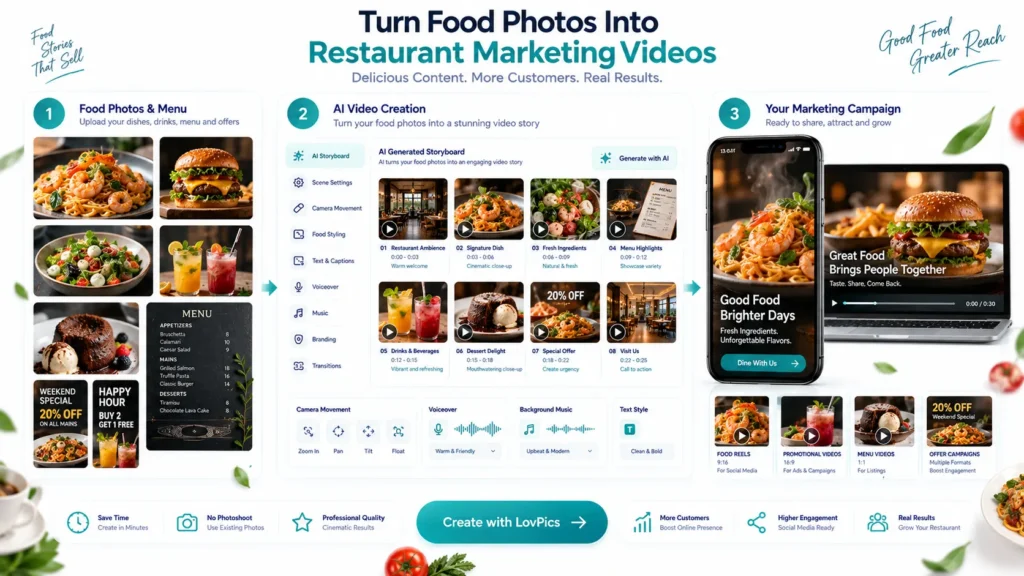
AI Video Marketing for Restaurants helps restaurants turn food photography, menu images, brand assets, and creative ideas into engaging promotional videos. Restaurants compete for attention every day. A customer scrolling through Instagram or Facebook may see dozens of restaurants, dishes, offers, delivery promotions, and food videos before deciding where to eat.
That makes visual content especially important for restaurants. A great food photograph can make a dish look appealing. Video can take that presentation further by adding movement, close-ups, atmosphere, storytelling, promotional messaging, and a clear call to action.
But creating restaurant videos regularly can be challenging. Restaurants need content for new menu items, seasonal dishes, special offers, festivals, weekend promotions, delivery campaigns, events, and social media.
Traditional video production can make frequent content creation difficult, especially for smaller restaurants and multi-location businesses.
AI video marketing provides another approach. Instead of creating every promotional video through a new production shoot, restaurants can use existing food photography, menu images, brand assets, scripts, and creative instructions as the foundation for additional video content.
This makes AI Video Marketing for Restaurants useful for promoting dishes, menus, offers, launches, social media campaigns, and other restaurant marketing activities.
Why Video Is Powerful for Restaurant Marketing
Food is highly visual. People make quick judgments about presentation, freshness, variety, atmosphere, and value based on what they see. Video can help restaurants communicate these qualities more dynamically.
Food Looks More Engaging in Motion
A still food image can show presentation.
A video can introduce:
- Close-up dish shots
- Camera movement
- Multiple dishes
- Restaurant atmosphere
- Menu highlights
- Promotional messages
- Preparation-inspired visuals
- Calls to action
The result can feel more dynamic than a static menu image.
Restaurants Need Frequent Content
Restaurant marketing is rarely a one-time campaign.
Businesses may need content for:
- Daily specials
- Weekend offers
- New dishes
- Seasonal menus
- Festival promotions
- Lunch deals
- Dinner promotions
- Delivery offers
- Events
- Restaurant announcements
A scalable video workflow can make frequent content production more practical.
Offers Need Attention Quickly
Promotional content often has a short lifespan.
A restaurant may want to promote:
- 20% off this weekend
- New menu
- Lunch combo
- Buy one, get one
- Festival special
- Happy hour
- Limited-time dessert
AI can help marketers turn the offer into visual content quickly, provided the offer details are verified before publishing.
The Challenges of Traditional Restaurant Video Production
Professional food video can be highly effective, but producing it repeatedly requires resources.
Every Dish Can Need Different Presentation
A biryani, pizza, burger, dessert, beverage, or fine-dining dish may require different visual treatment.
Production teams may need to plan:
- Food styling
- Lighting
- Camera angles
- Props
- Background
- Composition
- Movement
- Editing
This makes frequent production more difficult.
Restaurants Need Content Faster Than Traditional Production Allows
A restaurant promotion may only run for a few days.
If creating a video requires a full production cycle, the campaign can become difficult to execute quickly.
Large Menus Create a Content Challenge
Restaurants can have dozens or hundreds of menu items.
Creating professional videos for every dish through traditional production may not be practical.
Social Media Requires Constant Freshness
A restaurant that posts the same food images repeatedly may struggle to maintain attention.
Short-form video creates another format for presenting the same menu and offers.
What Is AI Video Marketing for Restaurants?
AI video marketing for restaurants uses AI-powered visual and video creation workflows to transform food photographs, menu references, scripts, and marketing instructions into promotional videos.
The process can begin with assets a restaurant already has: Food Photos + Menu Information + Brand Assets
These can become: Creative Concept → Storyboard → AI Video → Branding → Publish
Depending on the campaign, the resulting content can focus on:
- Individual dishes
- Menu collections
- New launches
- Restaurant offers
- Seasonal promotions
- Events
- Delivery campaigns
- Social media reels
- Brand storytelling
LovPics AI Video Gen supports up to four reference images, motion types such as product showcase, 360° turn, and lifestyle, custom instructions, 9:16 and 16:9 formats, combined video exports, background music, subtitles, logo overlays, and branded outro cards.
These general capabilities can support restaurant marketing workflows when appropriate food and menu references are supplied.
Build a Restaurant Video Strategy Before Creating Content
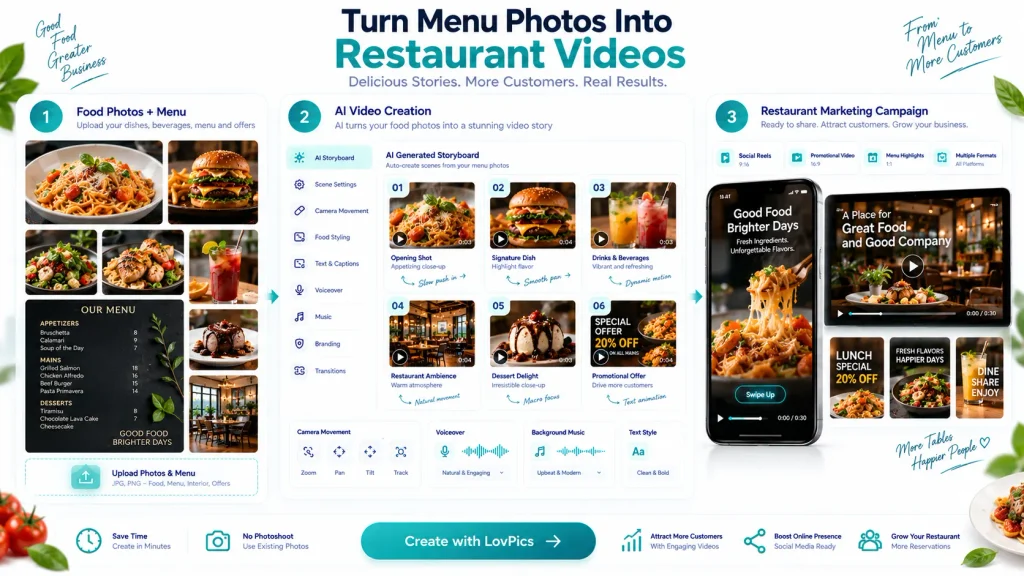
Generating videos is only one part of restaurant video marketing. The first step is deciding what the content needs to accomplish.
Define the Marketing Objective
Different videos can serve different goals.
- Awareness
- Introduce the restaurant or its signature dishes.
- Engagement
- Create visually appealing social content.
- Menu Promotion
- Highlight specific dishes or menu categories.
- Conversion
- Encourage customers to order, reserve, visit, or enquire.
- Promotion
- Drive attention to a limited-time offer.
- Retention
- Bring existing customers back with new dishes or offers.
The objective should determine the video’s message and CTA.
Identify the Audience
A restaurant may target:
- Local residents
- Families
- Office workers
- Students
- Tourists
- Delivery customers
- Event customers
- Premium diners
A lunch offer for office workers should not necessarily use the same creative approach as a weekend family promotion.
Organize Content into Pillars
A useful restaurant video strategy can include:
- Signature Dishes: Focus on the restaurant’s most recognizable or popular dishes.
- New Menu Items: Introduce new dishes and menu additions.
- Offers: Promote discounts, combos, and limited-time deals.
- Seasonal Campaigns: Create content around festivals, holidays, and seasonal occasions.
- Restaurant Experience: Show the dining environment, ambience, and overall experience.
- Events: Promote live events, celebrations, special menus, or restaurant activities.
- Delivery: Highlight delivery-focused offers and ordering messages.
This creates a balanced content calendar.
Related LovPics AI Solutions
- AI Video Gen: Use property images as visual references and create motion-led video segments with custom instructions, multiple clips, different aspect ratios, music, subtitles, logos, and branded outros.
- AI Reels: AI Reels can support short-form social video workflows using concepts, storyboards, scripts, music, branding, and platform-oriented video content.
- AI Stories: For a property that needs a more narrative presentation, AI Stories can turn a narrative or script into scene-based video segments and combine them into a longer story.
- AI Banners: Property campaigns can extend beyond video into banner creatives using reference images, instructions, multiple styles, aspect ratios, and multilingual content.
- AI Posters: Property launches, open-house promotions, and campaign announcements can also be adapted into poster formats where appropriate.
- Multi-Frame 360 Generation: Where the available visual workflow is appropriate, multi-frame generation can help create rotating visual presentations. It should not be presented as a substitute for an accurate physical property tour unless the output has been carefully validated.
How to Create AI Videos for Restaurant Marketing
Step 1: Collect High-Quality Food Images
Start with the strongest food photography available.
Useful references may include:
- Main dishes
- Desserts
- Beverages
- Combo meals
- Menu categories
- Restaurant interiors
- Packaging
- Brand assets
Food images should clearly represent the actual dishes.
Step 2: Decide What the Video Should Promote
Do not begin with the video effect.
Begin with the marketing message.
For example:
Signature Dish Video: Meet our bestselling butter chicken.
New Menu Video: Something new has arrived.
Offer Video: Weekend special, available for a limited time.
Combo Video: Everything you need for lunch.
The creative direction should follow the objective.
Step 3: Choose the Right Format
For short-form social content, 9:16 vertical video is often a practical format.
It can be used for:
- Instagram Reels
- YouTube Shorts
- Mobile advertising
- Social media campaigns
16:9 landscape can be useful for:
- YouTube
- Websites
- Presentations
- Restaurant screens
- Other landscape placements
LovPics AI Video Gen supports both 9:16 and 16:9 output.
Step 4: Select a Visual Direction
Different food campaigns can use different creative styles.
Premium restaurant:
- Elegant presentation
- Controlled movement
- Refined backgrounds
- Cinematic lighting
Casual restaurant:
- Bright visuals
- Fast pacing
- Energetic transitions
- Social-first presentation
Dessert campaign:
- Macro close-ups
- Texture-focused shots
- Slow movement
- Rich visual presentation
The visual style should match the restaurant brand.
Step 5: Define the Motion
Food videos do not always need complicated movement.
Useful directions can include:
- Slow camera push-in
- Dish reveal
- Macro close-up
- Gentle camera movement
- Multi-dish presentation
- Tabletop movement
- Lifestyle movement
Keep the food as the visual hero.
Step 6: Create the Storyboard
A simple restaurant video can follow: Hook → Dish → Detail → Offer → CTA
For example:
Hook: Craving something special?
Dish: Show the hero dish.
Detail: Show close-up food presentation.
Offer: Weekend combo available now.
CTA: Order today.
A storyboard makes the video easier to structure before generation.
Step 7: Write the Script
Restaurant scripts should be short and easy to understand.
For example:
Freshly prepared. Packed with flavour. Try our new weekend special today.For a promotional campaign:
Your weekend just got better. Enjoy our special family combo for a limited time.The exact claims and offer details should always match the restaurant’s actual promotion.
Step 8: Generate the Video
Once the references, creative direction, storyboard, and instructions are ready, generate the video.
LovPics AI Video Gen supports up to four clip images and can generate concepts for individual clips before combining them into a final video.
This can be useful when a restaurant wants to move through multiple dishes or visual references in one campaign.
Step 9: Review the Food Presentation
This step is critical.
AI-generated food visuals should be compared with the actual dish.
Check:
- Dish appearance
- Ingredients
- Portion presentation
- Garnishes
- Packaging
- Colors
- Restaurant branding
- Menu details
The generated visual should not create expectations that the restaurant cannot meet.
Step 10: Add Branding
A restaurant video can include:
- Restaurant logo
- Brand name
- Offer
- Website
- Ordering direction
- Contact information
- CTA
LovPics supports company logo overlays and branded outro cards within its AI video workflow.
Step 11: Add Music and Subtitles
Music can help establish the mood.
A restaurant can select audio appropriate to the campaign, while subtitles can communicate key information even when viewers watch without sound.
LovPics supports background music and advanced subtitle capabilities in its AI video workflow.
Step 12: Export and Publish
The finished video can be adapted for:
- Social media
- Restaurant websites
- Paid advertising
- Digital menus
- Promotional campaigns
- Online ordering campaigns
- Presentations
How Restaurants Can Scale AI Video Marketing
The biggest opportunity comes from building a repeatable system.
Start with Signature Dishes
Do not try to create videos for every menu item immediately.
Start with:
- Bestsellers
- Signature dishes
- High-margin items
- New menu items
- Popular combos
- Seasonal products
Measure engagement and conversion before expanding.
Create Multiple Videos from One Dish
One food image can support several concepts.
For example:
Dish Image
- Signature Dish Showcase
- Close-Up Food Reel
- Promotional Offer
- Combo Video
- Seasonal Creative
- Retargeting Ad
This increases the value of existing food photography.
Build Reusable Video Templates
A restaurant can establish repeatable formats.
For example:
Hook → Dish → Benefit → Offer → CTA
or:
New Dish → Ingredients → Presentation → Price/Offer → CTA
Once a format performs well, it can be reused across other menu items.
Create Offer-Specific Variations
One offer can be presented in multiple ways.
For example:
- Dish-first
- Offer-first
- Lifestyle-first
- Value-first
This gives restaurants more opportunities to test what attracts customers.
Build a Restaurant Content Library
Organize content by:
- Dish
- Menu category
- Campaign
- Offer
- Platform
- Date
- Audience
- Location
For multi-location restaurants, location-based organization becomes especially useful.
Related LovPics AI Video Solutions
The LovPics source does not document a restaurant-specific video module. The following general capabilities are therefore relevant to restaurant marketing workflows.
AI Video Gen
Create motion-led videos from up to four visual references with custom instructions, multiple motion types, 9:16 or 16:9 output, music, subtitles, logo overlays, and branded outros.
AI Reels
Create short-form social content with concept and storyboard previews, scripts, music, karaoke subtitles, advanced subtitles, branding, and branded outro cards.
Voice-over Reels
For restaurants that want a narrated food story or promotional advertisement, the Voice-over Reels workflow supports marketing scripts, cinematic visuals, narrator voice selection, multiple durations, 9:16 or 16:9 output, branding, and multilingual scripts in supported languages.
AI Stories
Restaurants can use narrative-based video when the campaign requires a stronger story, such as a restaurant introduction, brand story, or campaign narrative.
AI Banners
A restaurant campaign can extend from video into promotional banners using reference images, custom instructions, multiple styles, aspect ratios, and multilingual generation.
AI Posters
Posters can complement restaurant campaigns for offers, events, new menus, and promotional announcements. The documented workflow supports platform-oriented formats, multilingual generation, and editable text.
AI Productshoot
For packaged food products, beverages, sauces, snacks, or other food products, AI Productshoot can create product imagery with backgrounds, surfaces, lighting, camera settings, text overlays, and ecommerce pack shots before video creation.
Real-World Applications for Restaurants
New Menu Launches
A new menu can generate an entire content sequence.
For example:
New Menu
- Teaser
- Hero Dish Video
- Category Reel
- Full Menu Promotion
- Launch Advertisement
This gives the launch more visibility than a single announcement.
Signature Dish Promotion
Restaurants can use short videos to give their best-known dishes more attention.
A video can focus on:
- Presentation
- Ingredients
- Texture
- Serving style
- Portion
- Restaurant positioning
The message should remain accurate to the actual dish.
Limited-Time Offers
AI video can help restaurants create quick promotional content for:
- Weekend offers
- Festival discounts
- Lunch combos
- Family meals
- Seasonal deals
- Limited-time menus
Because offers can change frequently, marketers should verify every promotional detail before publication.
Delivery Promotions
Restaurants can create videos designed around delivery campaigns.
The structure could be:
Craving → Dish → Offer → Ordering CTA
The visual focus remains on the food while the final frame communicates the ordering action.
Social Media Content
Restaurants can build a more consistent social presence using recurring video formats.
Examples include:
- Dish of the week
- New arrival
- Chef’s special
- Weekend offer
- Dessert highlight
- Combo promotion
- Seasonal menu
Restaurant Events
Restaurants hosting events can create promotional videos for:
- Live music
- Special dinners
- Private events
- Festival celebrations
- New menu nights
- Community events
Multi-Location Restaurant Marketing
Restaurant groups can use a centralized creative structure while adapting:
- Location
- Offer
- Menu
- Contact information
- CTA
This can help maintain brand consistency across locations.
Restaurant Advertising
AI-generated videos can be used as creative variations for paid advertising.
Different videos can emphasize:
- Bestselling dish
- Offer
- Restaurant ambience
- Value
- Convenience
- New menu
Performance data can then inform future creative production.
Across the LovPics Ecosystem
Restaurant marketing does not need to stop at video.
A food photograph or campaign concept can become the starting point for multiple content formats:
Food Photo
↓
AI Video
↓
Social Reel
↓
Voice-over Video
↓
Promotional Banner
↓
Restaurant Poster
↓
Campaign Creative
This makes it possible to build a connected visual workflow around the restaurant’s existing assets.
LovPics’ documented ecosystem combines AI Video Gen, AI Reels, AI Stories, AI Banners, AI Posters, AI Product Shoot, and other visual creation workflows.
Expand Restaurant Marketing with LovPics
The biggest opportunity is not simply creating one video for one dish.
It is turning every strong food photograph into multiple marketing opportunities.
For example:
One Dish Photo
- Food Showcase Video
- Social Reel
- Promotional Offer
- Voice-over Advertisement
- Banner
- Poster
- Campaign Creative
The same system can then be repeated across signature dishes, new menu items, seasonal campaigns, and promotional offers.
This changes how restaurants can approach content production.
Instead of asking: “How many food videos can we shoot?“
restaurants can start asking: “How many marketing assets can we create from every strong food image?“
That is a more scalable way to think about restaurant content.
Common Mistakes Restaurants Make
Using Weak Food Photography
AI video generation still depends on the quality of the visual reference.
Better approach: Start with clear, well-lit photographs where the dish is easy to identify.
Making the Food Look Different from the Real Dish
A generated video can create an attractive presentation that does not accurately represent what customers receive.
Better approach: Compare generated visuals against the actual dish before publishing.
Adding Ingredients That Are Not Actually Included
AI-generated food visuals can sometimes introduce details that were not present in the reference.
Better approach: Review ingredients, garnishes, toppings, and presentation carefully.
Overusing Visual Effects
Food should remain the hero.
Too many transitions, effects, or movements can make the content feel less appetizing.
Better approach: Use movement to enhance the food rather than distract from it.
Making Offers Unclear
A promotional video should communicate the offer quickly.
Better approach: Clearly display the promotion, eligibility, duration, and CTA using verified information.
Using Expired Promotions
Restaurant offers often change quickly.
Better approach: Maintain a clear approval process so outdated promotional videos are removed or archived.
Trying to Promote Too Many Dishes at Once
Showing too many dishes can reduce focus.
Better approach: Create focused videos around one hero dish, category, or offer.
Forgetting the CTA
A food video should lead somewhere.
Possible CTAs include:
- Order Now
- Visit Us
- Book a Table
- Explore the Menu
- Try It Today
- Reserve Your Table
Using One Video for Every Platform
Different channels have different content requirements.
Better approach: Create appropriate versions for vertical social media, websites, advertisements, and other placements.
The Future of AI Video Marketing for Restaurants
Restaurant content production is moving toward a model where every food image can support more than one marketing asset.
The traditional workflow might be: Dish → Food Shoot → Menu Photo → Publish
An AI-assisted workflow can expand that into:
Dish → Food Photography → AI Video → Social Reel → Advertisement → Offer Campaign → Retargeting
This does not mean professional food photography or videography will disappear.
High-end restaurant campaigns, chef-led productions, brand films, and productions requiring exact real-world footage can still benefit from traditional production.
AI is particularly useful when restaurants need additional content from existing assets.
The long-term opportunity is to make restaurant marketing more systematic.
A strong food photograph should not have to serve only as a menu image.
It can become the foundation for a larger content ecosystem.
Comparison Table
| Factor | Traditional Restaurant Video | AI-Assisted Restaurant Video |
|---|---|---|
| Starting Asset | Physical food shoot | Existing food/menu images |
| Camera Production | Usually required | Not required for image-driven workflows |
| Food Styling | Physical production | Based on supplied visual references |
| Production Workflow | Planning, shooting, editing | Reference, instructions, generation, review |
| New Offer Content | Requires new production | Easier to create variations |
| Social Variations | Additional editing | More scalable |
| Menu Scale | Difficult to film every dish | Easier to create content across selected items |
| Creative Testing | More production required | Easier to create multiple concepts |
| Product Accuracy | Captures actual dish directly | Requires careful review |
| Best Use | High-control food production | Fast, scalable marketing content |
AI video does not replace every type of restaurant production.
Professional filming remains valuable when a restaurant needs exact footage of chefs, food preparation, restaurant ambience, staff, events, or physical experiences.
AI becomes particularly useful for extending existing food photography into additional marketing content.
Decision Matrix
| Restaurant Marketing Need | Recommended Approach |
|---|---|
| Promote a signature dish | AI Food/Product Video |
| Launch a new menu | AI Video + AI Reels |
| Promote a limited-time offer | AI Reel + Promotional Banner |
| Create narrated restaurant content | Voice-over Reel |
| Promote a restaurant story | AI Stories |
| Create social content regularly | AI Reels |
| Promote packaged food products | AI Product shoot + AI Video |
| Create event promotion | AI Video + Poster |
| Test multiple offers | Multiple AI Video Variations |
| Need exact chef or restaurant footage | Traditional Video Production |
Frequently Asked Questions
What is AI video marketing for restaurants?
AI video marketing for restaurants uses AI-powered visual and video workflows to turn food images, menu references, scripts, and brand assets into promotional content.
Can restaurants create videos from food photos?
Yes. Food photographs can be used as visual references for suitable AI video workflows.
Do restaurants need a traditional video shoot for every dish?
Not necessarily. Existing food photography can be used to create additional video content for suitable marketing use cases.
Can I create restaurant reels for Instagram?
Yes. LovPics AI Reels supports short-form reel creation, including concepts, storyboards, scripts, music, subtitles, branding, and branded outros.
Can I create videos for restaurant offers?
Yes. Food images and promotional messaging can be combined into short-form marketing videos. Offer details should always be reviewed and verified before publishing.
Can I promote multiple dishes in one video?
Yes. LovPics AI Video Gen supports up to four clip images, allowing multiple visual references to be incorporated into a combined video workflow.
Can I add music to restaurant videos?
Yes. Background music is supported in the documented AI Video Gen and AI Reels workflows.
Can I add subtitles?
Yes. LovPics supports karaoke subtitles and advanced subtitle capabilities within its AI Reels workflow, as well as advanced subtitles within AI Video Gen.
Can I add my restaurant logo?
Yes. The documented video workflows support company logo overlays and branded outro cards.
Can I create narrated restaurant videos?
Yes. LovPics Voice-over Reels supports marketing scripts, cinematic visuals, narrator voice selection, multiple durations, branding, and 9:16 or 16:9 output.
Can AI videos accurately represent food?
They can use supplied food images as references, but restaurants should always review generated content against the actual dish.
AI-generated visuals should not create misleading expectations about ingredients, portion size, presentation, or other important characteristics.
How can restaurants scale AI video marketing?
Start with signature dishes and generous offers, create reusable video structures, produce meaningful variations, organize content by campaign and dish, and measure performance.
What should restaurants measure?
Useful metrics include:
- Video views
- Watch time
- Completion rate
- Engagement
- Profile visits
- Website visits
- Menu views
- Online orders
- Reservations
- Offer redemptions
- Cost per conversion
The right metrics depend on the campaign objective.
Conclusion
AI video marketing gives restaurants a practical way to turn existing food photography and menu assets into more engaging promotional content.
Instead of producing every video through a separate shoot, restaurants can use AI to create suitable variations for dishes, offers, launches, social media, and advertising.
The workflow can be:
Food Photo → Campaign Goal → Creative Direction → Storyboard → AI Video → Accuracy Review → Branding → Publish → Measure
One strong food image can then support multiple marketing assets:
Dish Video → Social Reel → Offer Creative → Voice-over Ad → Banner → Poster
The most important principle is accuracy.
A restaurant video should make the food look appealing without promising something the customer will not actually receive.
Used responsibly, AI video can help restaurants publish more consistently, promote time-sensitive offers faster, and get more marketing value from the food photography they already have.
The future of restaurant content is not simply about creating more food videos.
It is about turning every strong menu and food asset into more opportunities to attract customers, promote dishes, and drive orders or visits.