AI Video Personalization for E-commerce: Drive Conversions

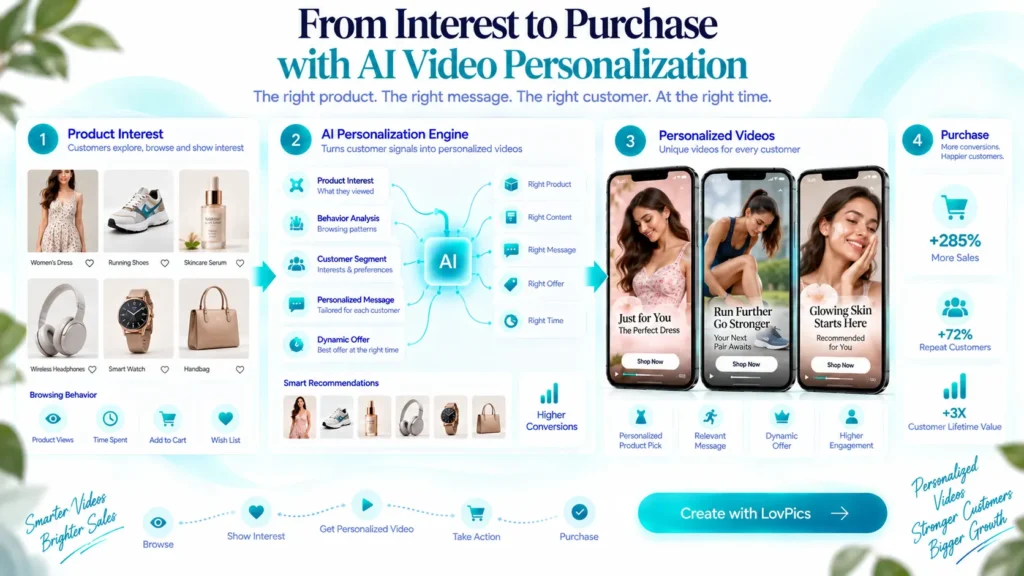
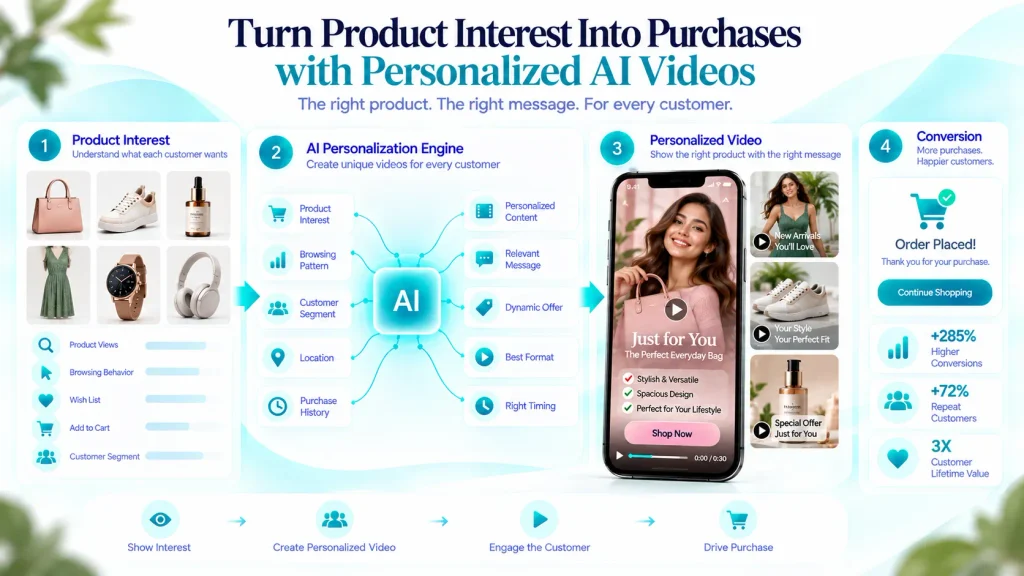
AI Video Personalization for E-commerce helps brands create more relevant video experiences based on product interest, customer context, and buying intent. E-commerce personalization has moved beyond simply adding a customer’s name to an email. Today’s shoppers expect brands to understand what they are interested in and show them products, messages, and experiences that feel relevant.
Video is becoming an important part of that experience. A shopper who has shown interest in a particular product does not necessarily need to see the same generic brand video as everyone else. They may respond better to a video focused on that product, its key benefit, a relevant use case, a complementary item, or an offer connected to their interest.
The challenge has traditionally been production. Creating one product video is already a significant task. Creating different versions for different products, audiences, campaigns, and customer situations can quickly become expensive and difficult to manage.
AI video personalization changes the economics of this process. Instead of producing every variation manually, ecommerce teams can build repeatable video structures and adapt the product, message, visuals, and CTA for different customer contexts.
The result is a shift from one video for everyone toward more relevant video experiences designed around product interest and buying intent.
Why Personalized Video Matters in E-commerce
E-commerce customers rarely move from discovering a brand directly to purchasing without additional consideration.
A typical journey may look like: Discover → Browse → Show Interest → Consider → Compare → Purchase
Each stage creates a different communication opportunity.
- A shopper discovering a category may need inspiration.
- A shopper who has viewed a particular product may need more information.
- A shopper comparing products may need help understanding differences.
- A shopper who abandoned a cart may need reassurance or a relevant incentive.
- A generic video cannot address all of these situations equally well.
Personalized video allows businesses to make the content more closely connected to what the shopper already cares about. This does not necessarily mean creating a completely unique video for every individual.
It can mean creating structured variations around meaningful signals such as:
- Product interest
- Product category
- Customer segment
- Purchase stage
- Previous interaction
- Product attributes
- Promotional eligibility
- Geographic market
- Language
- Campaign source
The objective is relevance.
The Gap Between Product Interest and Purchase
Product interest does not always become a sale.
A shopper may:
- View a product
- Spend time reading its description
- Watch an existing video
- Compare alternatives
- Add the product to a wishlist
- Add it to a cart
- Leave without purchasing
There are many reasons for this.
- The shopper may not fully understand the product.
- They may be comparing alternatives.
- They may need reassurance.
- They may be waiting for an offer.
- They may simply need another reminder.
- This creates an important opportunity for personalized content.
Instead of sending the same message to every visitor, businesses can create video experiences that address the specific point where interest has stalled.
For example:
- Product viewed → Personalized feature video
- Product compared → Personalized comparison video
- Cart abandoned → Product reminder video
- Accessory viewed → Complementary product video
The content becomes an extension of the customer’s existing interest.
What AI Video Personalization Means for E-commerce
AI video personalization is the process of using AI-assisted video creation and content workflows to produce video variations tailored to different products, audiences, customer signals, or marketing situations. The personalization can happen at several levels.
Product Personalization
The video focuses on the product the shopper has shown interest in.
For example, a fashion store could create different video versions for different dresses, shoes, or accessories.
Message Personalization
The product remains the same, but the explanation changes.
- One shopper may see a video focused on comfort.
- Another may see styling possibilities.
- Another may see durability or a specific product feature.
Offer Personalization
The video can emphasize a relevant promotion or purchasing incentive when appropriate. This can be particularly useful for retargeting campaigns.
Audience Personalization
Different customer segments can receive different video treatments.
For example:
- First-time shoppers
- Returning customers
- High-intent visitors
- Existing customers
- Category-specific audiences
Language Personalization
The same product story can be adapted for different languages and markets. This can make video content more accessible without rebuilding the entire creative concept from scratch.
Start With Product Interest Signals
Personalization is only useful when it is based on meaningful information. For ecommerce, product interest can come from several sources.
Product Page Views
A shopper repeatedly visiting a product page may indicate stronger interest than someone who simply saw an advertisement. A personalized video can focus on that specific product and reinforce its most important selling points.
Category Browsing
A shopper browsing running shoes may be more interested in content about running footwear than a generic brand video. Category-level personalization can therefore be useful when product-level intent is not yet clear.
Search Behavior
The terms customers search for can provide clues about what they want. Someone searching for “lightweight travel backpack” has a different information need from someone searching for “large laptop backpack.” Video messaging can reflect those differences.
Wishlist Activity
Wishlist behavior can indicate future purchase intent. A personalized video can remind shoppers about the product and highlight information they may have missed.
Cart Activity
Cart additions generally represent stronger purchase intent. Personalized video can reinforce product benefits, answer common concerns, or remind the shopper about the item.
Previous Purchases
Existing customers can receive content related to products that complement what they already own.
For example: Previous purchase → Complementary product → Personalized video
This can create opportunities for cross-selling without presenting completely unrelated products.
Build the Personalized Video Around the Customer’s Intent
The strongest personalization strategy starts with intent rather than technology.
Ask: What does this shopper need to know next?
- If the shopper has only discovered a product, the video might introduce its main benefit.
- If they have already viewed it several times, the video could focus on differentiating features.
- If they have added it to their cart, the video could address objections or reinforce confidence.
This produces a progression.
Awareness
“Here is what this product can do.”
Interest
“Here is why this product may be right for you.”
Consideration
“Here is what makes this product different.”
Purchase Intent
“Here is why you can confidently choose it.”
Personalized video becomes more useful when the message evolves with customer intent.
How to Create Personalized AI Videos for E-commerce
Define the Personalization Signal
Start with the information that determines the video variation.
For example:
- Product viewed
- Product category
- Customer segment
- Previous purchase
- Campaign audience
- Product variant
- Language
- Buying stage
Do not personalize simply because you can.
Choose signals that can meaningfully change the customer’s decision.
Create a Repeatable Video Structure
Instead of designing every video from scratch, establish a reusable structure.
A simple ecommerce format could be: Hook → Product → Key Benefit → Proof or Demonstration → CTA
For example:
- Hook: Looking for a lightweight everyday backpack?
- Product: Introduce the specific backpack.
- Benefit: Highlight lightweight construction.
- Demonstration: Show capacity and use.
- CTA: Explore the product.
The structure stays consistent while the content changes according to the product or customer context.
Prepare Product References
High-quality product references are important.
These can include:
- Product images
- Multiple product angles
- Existing campaign imagery
- Product details
- Brand guidelines
- Product descriptions
- Promotional information
AI video workflows can use these references as the foundation for creating different creative variations.
Create Product-Specific Scenes
The video should visually reflect the product being promoted.
For ecommerce, this could include:
- Hero product shot
- Close-up detail
- Product in use
- Feature demonstration
- Lifestyle context
- Product comparison
- Offer or CTA scene
The scenes should support the customer’s reason for considering the product.
Personalize the Message
Now adapt the message to the relevant customer signal.
For example, a shoe brand could create:
Comfort-focused video : “Designed for long days on your feet.”
Performance-focused video : “Built for your next training session.”
Style-focused video: “Designed to complete your everyday look.”
The product may remain the same.
The reason for buying changes.
Add the Appropriate CTA
The CTA should match the customer’s stage.
- For discovery: Explore the collection
- For product consideration: See product details
- For high purchase intent: Shop now
- For complementary products: Complete your look
The closer the CTA is to the customer’s intent, the more naturally it fits the experience.
Personalization Does Not Mean Creating Millions of Videos
One common misconception is that personalization requires creating a completely unique video for every shopper.
That is rarely necessary.
A more scalable approach is to create controlled variations.
For example: 10 products × 3 messaging angles × 2 formats
This creates 60 useful creative variations without requiring 60 completely different production processes.
Businesses can combine:
- Reusable scenes
- Product references
- Templates
- Voiceover variations
- Text variations
- CTAs
- Language versions
AI makes these combinations more practical.
The goal is not infinite personalization.
It is useful personalization at scale.
How Personalized Videos Can Support Different E-commerce Scenarios
Product Retargeting
A shopper views a product but leaves.
Instead of showing only a static product advertisement later, the brand can use a short personalized video focused on the product’s strongest benefit.
Cart Recovery
A shopper adds a product to their cart but does not complete the purchase.
A personalized video can remind them about the product and reinforce key benefits.
The message should feel useful rather than intrusive.
Cross-Selling
A customer purchases one product.
A follow-up video can introduce a complementary product.
For example:
Camera purchase → Compatible camera accessory
Dress purchase → Matching accessories
Coffee machine purchase → Compatible coffee products
Upselling
A shopper is considering a basic product.
A personalized video can explain the additional value of a premium version.
The key is to communicate the difference clearly rather than simply pushing the higher-priced option.
Product Discovery
When shoppers browse a broad category, personalized video can help narrow their choices.
A category-specific video can highlight popular products, important differences, or use cases.
Seasonal Campaigns
Personalized videos can also adapt product messaging to seasonal buying intent.
A fashion brand may use different video variations for:
- Festive shopping
- Wedding season
- Summer
- Winter
- Back-to-school
- Holiday gifting
The product remains relevant while the context changes.
How Businesses Can Scale Personalized Video Production
Personalization becomes valuable when it can be repeated.
Businesses should create a production system rather than treating each personalized video as an isolated creative project.
Create a Modular Video Library
Build reusable components for:
- Hooks
- Product introductions
- Feature explanations
- Benefit scenes
- Lifestyle scenes
- Offers
- CTAs
- Brand outros
These modules can then be combined into different video variations.
Use Reusable Templates
When a video format performs well, preserve its structure.
Reusable templates can help teams maintain consistency across products while changing the elements that need to be personalized.
LovPics supports reusable creative structures so businesses can retain effective visual layouts and apply them across campaigns and product collections.
Build Product-Level Creative Assets
Instead of producing one asset and stopping, build a library around each product.
For example:
Product A
- Product photos
- Product video
- Feature explainer
- Retargeting video
- Social Reel
- Offer variation
- FAQ video
This makes future personalization faster.
Create Multiple Versions From the Start
When developing a campaign, consider the likely variations before production begins.
For example:
Product × Audience × Message × Format
This creates a scalable creative matrix.
AI is particularly useful when the number of combinations begins to grow beyond what a traditional production team can comfortably manage.
Measuring Whether Personalized Video Is Working
Personalization should be measured against business outcomes, not just video views.
Important metrics include:
Click-Through Rate
Are viewers taking the next action after watching?
Product Page Engagement
Does personalized video encourage shoppers to spend more time engaging with the product?
Add-to-Cart Rate
Does the video help move interested shoppers toward adding the product to their cart?
Conversion Rate
The most important question is whether personalized video contributes to more purchases.
Return on Ad Spend
For paid campaigns, compare the commercial performance of personalized video creatives against generic alternatives.
Creative-Level Performance
Measure different:
- Hooks
- Product angles
- Messages
- CTAs
- Video lengths
- Formats
This can reveal which personalization variables actually matter.
Related LovPics AI Video Solutions
LovPics provides several capabilities that can support an ecommerce personalization workflow.
AI Product Video Maker
Turn product images and brand assets into short-form product videos for ecommerce, marketplaces, and social campaigns.
Product Reels
Create structured product reels from product stills with multiple visual beats and CTA moments.
UGC Product Showcase Reels
Use creator-style presentation when a personalized video benefits from a human-led product explanation.
AI Reels
Build storyboard-driven videos with visual scenes, voiceover pacing, music, branding, and CTA elements.
AI Product Photography
Create product visuals that can serve as references for personalized video variations.
AI 360° View
Use multi-angle product visuals when shoppers need a better understanding of the product before purchasing.
Reusable Templates
Preserve successful creative structures and apply them across products and campaigns.
AI Fashion Photoshoot
Create consistent on-model visuals for fashion products that can be incorporated into personalized ecommerce video content.
E-Commerce Pack
Create coordinated product, model, banner, and ecommerce imagery that can support personalized campaigns.
AI Banner Generator
Create supporting personalized campaign creatives around the same products and messaging used in video.
Real-World Applications of E-commerce Video Personalization
Fashion E-commerce
Fashion brands can personalize videos based on product category, style preference, season, or previous browsing behavior.
A shopper interested in dresses can see dress-focused content, while another interested in accessories can receive a different video experience.
Beauty and Skincare
Beauty brands can personalize content around customer needs such as hydration, skincare routines, makeup looks, or product categories.
Instead of promoting an entire catalog, the video can focus on the products relevant to the shopper’s interest.
Electronics
Electronics brands can personalize videos around features, use cases, and product tiers.
A shopper researching cameras may need a different message from someone researching headphones.
Home and Lifestyle
Home brands can use personalized video to show products in relevant contexts.
For example, someone interested in home organization may see storage-focused product demonstrations rather than a generic brand video.
Jewelry
Jewelry brands can create personalized product videos around collections, occasions, styles, and gifting moments.
The same product can be positioned differently depending on the customer’s shopping context.
Marketplace Sellers
Marketplace sellers can use personalized video variations to highlight product benefits, demonstrate usage, and create differentiated creative for advertising campaigns.
Across the LovPics Ecosystem
Video personalization becomes more powerful when it connects with the rest of an ecommerce content workflow.
A business can start with product imagery, create multiple product concepts, generate supporting ecommerce assets, develop video variations, and reuse successful structures across campaigns.
The broader workflow can look like:
Product Data → Product Visuals → Creative Concepts → Personalized Video → Campaign → Performance Insights
Performance data can then influence the next round of creative.
This creates a feedback loop where businesses continuously learn which products, messages, scenes, and CTAs perform best.
AI makes it easier to act on those insights by reducing the production effort required to create new variations.
Expand E-commerce Video Personalization With LovPics
LovPics can help businesses build the visual production layer needed for scalable ecommerce personalization.
Instead of producing every product video manually, teams can create reusable creative structures and adapt product visuals, scenes, messaging, and formats across different campaigns.
This is particularly useful for businesses managing large catalogs.
The objective is not to make every video completely different.
It is to make each video more relevant to the reason the customer is watching it.
When product interest becomes the starting point for video creation, businesses can create content that feels more connected to the customer’s journey.
Common Mistakes Businesses Make With Personalized E-commerce Videos
Personalizing Without a Clear Purpose
Changing a customer’s product name or inserting superficial personalization does not necessarily make a video more useful.
Better approach: Personalize something that changes the customer’s experience, such as the product, benefit, use case, message, or CTA.
Creating Too Many Variations
More variations do not automatically mean better personalization.
Better approach: Start with a small number of meaningful segments and test them.
Ignoring Customer Intent
Showing the same promotional message to someone discovering a product and someone who has already added it to their cart can feel disconnected.
Better approach: Match the video message to the customer’s stage.
Making Personalization Intrusive
Customers should not feel uncomfortable because a brand appears to know too much about their behavior.
Better approach: Keep personalization useful, relevant, and appropriate to the marketing context.
Focusing Only on Clicks
A personalized video can generate clicks without generating meaningful purchases.
Better approach: Connect video metrics to add-to-cart, conversion, revenue, and campaign efficiency.
Sacrificing Brand Consistency
Personalized content should still look and feel like it belongs to the same brand.
Better approach: Use consistent visual language, product presentation, typography, messaging principles, and brand assets.
Creating Variations Without Testing
Assuming one personalization strategy will work for every audience can lead to wasted production.
Better approach: Test different hooks, benefits, product angles, and CTAs.
Forgetting the Product
Personalization should not overwhelm the actual product.
Better approach: Keep the product central and make the personalization support the customer’s decision.
The Future of AI Video Personalization in E-commerce
E-commerce personalization is moving toward increasingly dynamic content experiences.
As AI video production becomes easier, businesses will be able to create more combinations of:
Product + Audience + Message + Context + Language + Offer + Format
This creates a new opportunity for ecommerce teams.
Instead of asking:
“Which video should we make?”
They can begin asking:
“Which video should this customer see?”
That is a significant shift.
The future of ecommerce video will not necessarily be about producing the most videos.
It will be about producing the most relevant versions of the right videos.
Brands that build modular creative systems will be better positioned to respond to changing products, audiences, campaigns, and customer behavior without rebuilding their entire production process every time.
Comparison Table
| Traditional E-commerce Video | Personalized AI Video |
| One primary version | Multiple targeted variations |
| Broad audience messaging | Audience or intent-specific messaging |
| High production effort for variations | Repeatable AI-assisted workflow |
| Product-specific production | Product and message combinations |
| Manual adaptation | Template-driven adaptation |
| Limited creative combinations | Large creative variation matrix |
| Often campaign-based | Can support ongoing customer journeys |
| More difficult to scale across catalogs | Better suited to large product catalogs |
Decision Matrix
| E-commerce Need | Personalized Video Approach |
| New product discovery | Category or product-focused video |
| Product retargeting | Product-specific benefit video |
| Cart recovery | Product reminder or objection-focused video |
| Cross-selling | Complementary product video |
| Upselling | Premium feature comparison |
| Seasonal campaigns | Context-specific product messaging |
| International expansion | Language-specific video variations |
| Large product catalog | Template-based product variations |
Frequently Asked Questions
What is AI video personalization for e-commerce?
AI video personalization for e-commerce is the use of AI-assisted video workflows to create different product videos based on factors such as product interest, audience, customer intent, messaging, language, or campaign context.
How can personalized videos increase ecommerce conversions?
Personalized videos can make product communication more relevant to what a shopper is already interested in. They can explain benefits, demonstrate products, address potential objections, and provide more relevant calls to action.
Does every customer need a unique video?
No. Businesses can create meaningful variations around products, customer segments, buying stages, messages, and formats rather than generating a completely unique video for every individual.
What customer signals can be used for video personalization?
Depending on the ecommerce setup, signals can include product views, category browsing, search behavior, wishlist activity, cart activity, previous purchases, customer segments, language, and campaign source.
Can personalized videos be used for retargeting?
Yes. Personalized video can be particularly useful for retargeting because the content can focus on products or categories that shoppers have already shown interest in.
Can AI personalize product videos for different products?
Yes. Product references and reusable creative structures can be combined to create product-specific video variations.
Can the same personalized video strategy work across different markets?
The underlying structure can remain consistent while messaging, language, product context, and other elements are adapted for different markets.
How should ecommerce brands measure personalized video performance?
Measure outcomes such as click-through rate, product engagement, add-to-cart rate, conversion rate, revenue, and return on ad spend. Creative-level testing can also reveal which personalization approaches perform best.
Is personalized video useful for small ecommerce businesses?
Yes. Small businesses do not need thousands of variations. Even a few meaningful product, audience, or message variations can make campaigns more relevant.
What is the biggest benefit of AI for ecommerce video personalization?
The biggest benefit is scalability. AI can reduce the production effort involved in creating and adapting multiple video variations, making personalized creative more practical for businesses with large catalogs and frequent campaigns.
Conclusion
E-commerce personalization is ultimately about relevance.
When a customer has already shown interest in a product, the next video they see should ideally help them understand, evaluate, or act on that interest.
AI makes it easier to create those experiences at scale.
Businesses can combine product references, reusable video structures, different messages, customer signals, languages, and calls to action to create targeted video variations without producing every asset from scratch.
The most effective approach is not unlimited personalization.
It is purposeful personalization.
Start with a customer signal. Identify the next question that needs to be answered. Build a focused video around that intent. Then measure whether the content helps move the shopper closer to purchase.
For ecommerce brands, that creates a practical path from:
Product Interest → Relevant Video → Greater Confidence → Conversion.