AI Product Photography for Fashion Brands

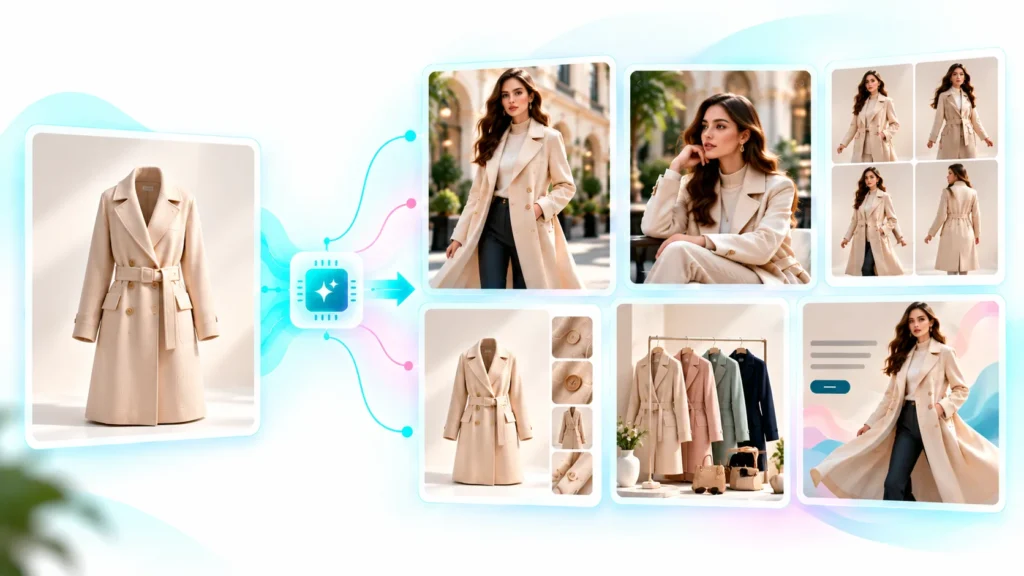
AI Product Photography is becoming increasingly useful for fashion brands that need strong visual content throughout the customer journey. A shopper may first discover a garment through social media, see it again in an advertisement, visit an online store, and compare several product images before deciding whether to buy.
This makes product photography much more than a catalogue requirement. It is part of how a fashion brand communicates quality, style, fit, and identity online.
The challenge is that fashion collections can contain dozens or hundreds of products, colors, and variations. Every product may need clean ecommerce images, model photography, lifestyle visuals, campaign imagery, and additional content for social media.
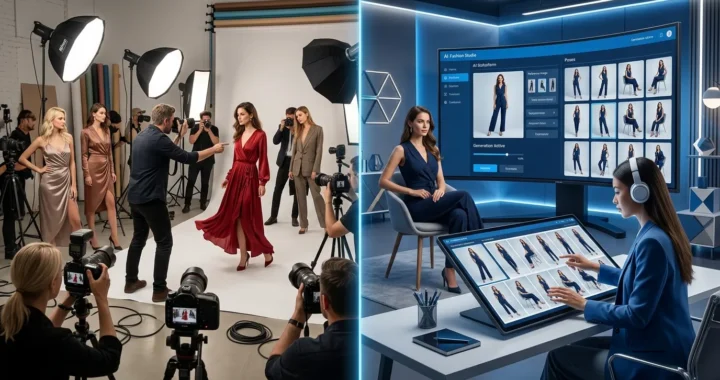
Traditional fashion photography can produce excellent results, but it also involves models, photographers, locations, styling, lighting, equipment, and post-production. Repeating that process for every collection can become expensive and difficult to scale.
AI Product Photography for Fashion Brands provides another approach.
With AI-powered workflows, fashion businesses can use product references to create different types of visual content while reducing repetitive production work. The goal is not simply to generate images. It is to create accurate, consistent, and useful fashion visuals that can support ecommerce, marketing, and campaign production.
Why Fashion Brands Need Better Product Photography
Fashion is highly visual, and customers often make their first impression of a product from its images.
A clothing product page may need several views to communicate the garment properly. Customers may want to understand the silhouette, material, color, details, and overall appearance before purchasing.
Social media introduces another requirement.
A product photograph designed for an ecommerce catalogue may not be the best format for Instagram, advertising or short-form video. Fashion brands therefore need different visual treatments for different marketing channels.
This creates a production challenge.
A growing fashion brand needs enough content to support its entire collection without allowing production requirements to slow down launches.
AI product photography can help address this challenge by making it easier to create multiple visual treatments from existing product references.
The Photography Challenges Fashion Brands Face
Every Collection Requires New Visual Content
Fashion collections change frequently. New seasonal collections, limited editions, color variations, and product drops all require fresh visuals.
When every product requires a traditional shoot, photography can quickly become a bottleneck.
Fashion Products Need Multiple Presentations
A single garment may need several types of imagery.
For example, a fashion brand may require:
- Clean product photography
- Front and back views
- On-model imagery
- Multiple poses
- Lifestyle scenes
- Collection visuals
- Promotional imagery
- Social media creatives
Producing each variation separately increases the workload.
Color Variations Increase Production Requirements
Fashion brands frequently sell the same design in several colors. Traditional photography may require photographing each variation individually.
AI workflows can help brands explore color-specific visual production using appropriate product references and controlled creative instructions.
Maintaining Consistency Is Difficult
A collection should look like a collection. Lighting, model presentation, composition, backgrounds and image quality should feel connected across the catalogue.
When images are produced through different shoots or teams, maintaining that consistency can become difficult.
Related LovPics AI Solutions
- AI Video Gen: Use property images as visual references and create motion-led video segments with custom instructions, multiple clips, different aspect ratios, music, subtitles, logos, and branded outros.
- AI Reels: AI Reels can support short-form social video workflows using concepts, storyboards, scripts, music, branding, and platform-oriented video content.
- AI Stories: For a property that needs a more narrative presentation, AI Stories can turn a narrative or script into scene-based video segments and combine them into a longer story.
- AI Banners: Property campaigns can extend beyond video into banner creatives using reference images, instructions, multiple styles, aspect ratios, and multilingual content.
- AI Posters: Property launches, open-house promotions, and campaign announcements can also be adapted into poster formats where appropriate.
- Multi-Frame 360 Generation: Where the available visual workflow is appropriate, multi-frame generation can help create rotating visual presentations. It should not be presented as a substitute for an accurate physical property tour unless the output has been carefully validated.
What Is AI Product Photography for Fashion Brands?
AI product photography uses artificial intelligence to create or transform fashion product visuals from product references. Instead of requiring a complete physical photoshoot for every visual requirement, a fashion brand can start with product imagery and use AI workflows to develop different presentations.
Depending on the workflow, this can include:
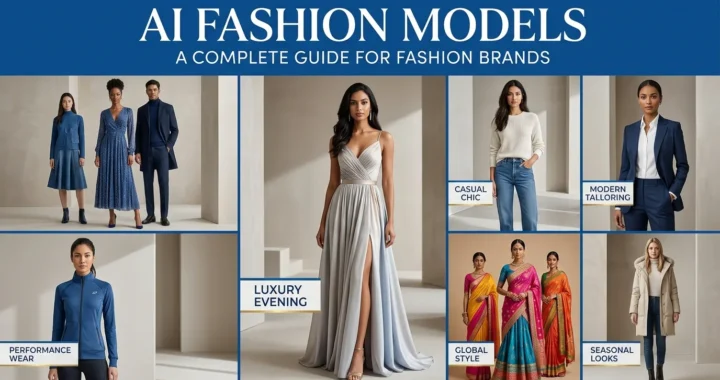
- Ecommerce product images
- On-model fashion images
- Lifestyle visuals
- Different poses
- Different backgrounds
- Collection imagery
- Promotional visuals
- Social media content
- Campaign concepts
- Product variations
The most useful application is not random image generation. It is controlled visual production based on the actual fashion product.
How AI Product Photography Works for Fashion Brands
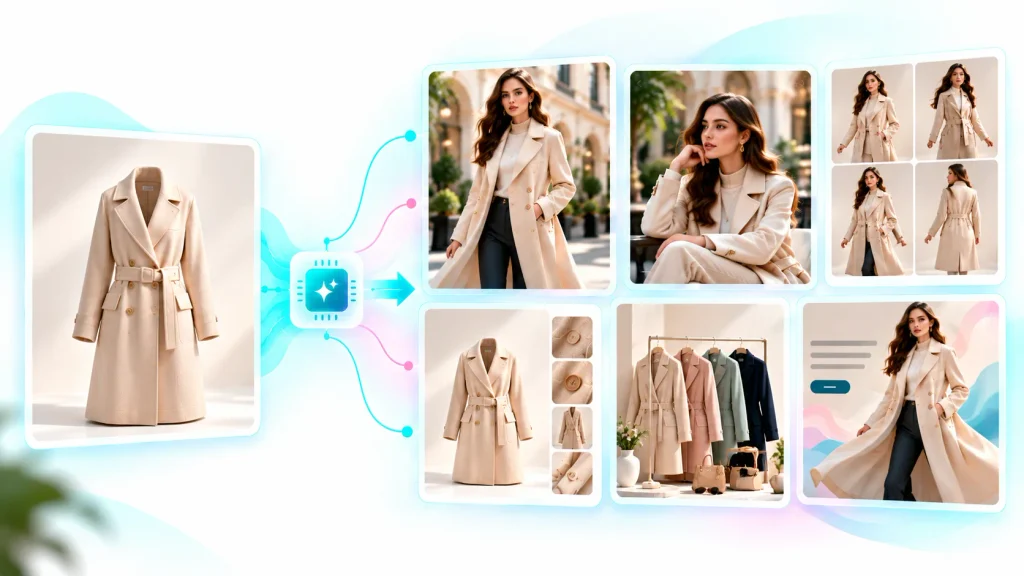
A practical workflow can begin with a clear product image. The product reference provides the foundation for generating additional visual presentations. The brand can then define the desired model, pose, environment, lighting and overall creative direction.
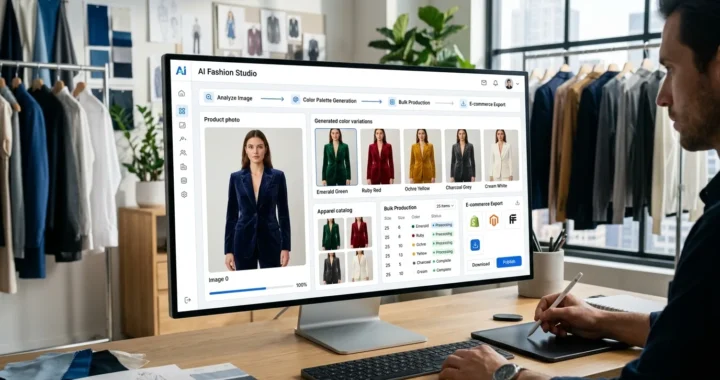
A typical workflow can be: Product Reference → AI Fashion Direction → Model / Scene → Multiple Visuals → Review → Export
This makes it possible to create several related assets around the same product.
The workflow can also be extended into campaign production.
Product → Product Photography → Model Images → Lifestyle Visuals → Social Creatives → Campaign
The important point is that the product remains at the center of the workflow.
Creating Clean Ecommerce Product Images
Fashion ecommerce still needs clean product photography. Customers should be able to understand the product without unnecessary distractions.
AI product photography can help create consistent product presentations with controlled backgrounds and lighting.
This can be useful for:
- Ecommerce product pages
- Fashion catalogues
- Collection pages
- Marketplace listings
- Product feeds
- Online stores
Clean product imagery can also provide the foundation for other marketing assets.
A strong product reference can subsequently be used for model imagery, lifestyle scenes and campaign visuals.
Creating On-Model Fashion Photography
On-model photography gives shoppers additional context. Instead of seeing only the garment, customers can see how the product is presented on a model. AI fashion workflows can support this type of visual production using apparel product references.
Brands can create different poses and presentation styles while keeping the product as the central reference.
This can be useful for:
- Clothing catalogues
- Collection launches
- Social media
- Product pages
- Advertising
- Lookbooks
For fashion brands, consistency is especially important. The model, lighting and visual direction should feel appropriate to the brand and collection.
Creating Multiple Poses
One product does not need to appear in only one pose.
Different poses can communicate different aspects of a garment.
A standing pose can show the overall silhouette. A side pose can show shape and fit. A movement-based pose can communicate how the garment behaves in a lifestyle context.
AI can make it easier to create multiple pose directions from the same product reference.
This can help brands build richer product galleries without requiring a separate physical shoot for every pose.
Supporting Different Backgrounds and Environments
Fashion products can be presented in several visual environments.
A clean studio background may work well for a catalogue.
A lifestyle environment may work better for social media.
An editorial environment may support a campaign.
AI visual workflows can help brands explore these different presentations while keeping the product central to the creative direction.
This gives fashion teams more flexibility when creating content for different channels.
Creating Lifestyle Fashion Photography
Lifestyle imagery helps customers understand the context around a fashion product.
A dress can be presented in an occasion-based environment. Casual apparel can be shown in an everyday setting. Outdoor clothing can be placed into a relevant lifestyle scene.
AI can help fashion brands create these contextual visuals without requiring a physical location for every concept.
The key is to maintain realistic product representation.
The environment should enhance the product rather than distract from it.
Supporting Fashion Collections
Fashion brands rarely sell products individually.
They sell collections.
A collection should therefore have a visual relationship between its products.
AI product photography can help create consistent visual structures across a collection.
For example, a brand could define:
- Similar lighting
- Consistent model presentation
- Similar backgrounds
- Common image composition
- Consistent visual tone
These rules can then be applied across multiple products.
This creates a stronger catalogue experience.
Creating Visuals for Different Product Colors
Color variants are common in fashion.
A single design may be available in black, white, beige, blue, green or several seasonal colors.
Traditional production requires accurate photography of each variation.
AI can support visual workflows for color-specific content when accurate product references are available.
However, fashion brands should always review color outputs carefully.
Small differences in tone can influence customer expectations, especially when the exact product color is important.
How Businesses Can Scale AI Fashion Product Photography
AI product photography becomes more useful when it is treated as a production system.
Create a Standard Product Input
Start with high-quality product references.
The clearer the product details, the easier it is to maintain visual accuracy.
Define a Visual Direction
Decide how the brand should look before creating hundreds of images.
Define the preferred:
- Model style
- Lighting
- Backgrounds
- Poses
- Composition
- Image ratios
- Overall visual tone
Create Collection-Level Rules
Do not define everything separately for every product.
Create visual rules that can be reused across a collection.
This helps maintain consistency.
Build Reusable Templates
Once a successful visual structure has been created, reuse it.
Reusable templates can reduce repetitive creative work and make it easier to maintain a consistent fashion catalogue.
Review Before Publishing
AI-generated fashion imagery should always go through quality control.
Check:
- Garment shape
- Color
- Pattern
- Product details
- Accessories
- Model presentation
- Image quality
- Brand consistency
Human review remains an important part of the workflow.
Related LovPics AI Solutions
Fashion brands can combine several LovPics capabilities with AI product photography:
- AI Fashion Studio for model-based fashion imagery.
- AI Fashion Photoshoot for studio-style fashion production.
- Multi-Pose Generation for creating different model poses.
- Apparel Color Switch for exploring apparel color variations.
- E-commerce Image Packs for structured product image sets.
- Bulk Image Export for managing larger content requirements.
- AI Retouch for image enhancement and cleanup.
- AI Product Photography for clean product visuals.
- Reusable Templates for consistent collection production.
- E-commerce Pack for combining product, model and marketing visuals.
These capabilities can work together as part of a broader fashion content workflow.
Real-World Applications
New Fashion Collection Launches
When a new collection launches, brands need a large amount of content in a short period.
AI product photography can help create product images, model visuals and campaign assets around the same collection.
This can reduce the time between product development and digital publication.
D2C Fashion Brands
D2C brands often need to move quickly while managing limited creative resources.
AI visual production can help them create more content from their existing product assets.
This is particularly useful when new products are introduced frequently.
Online Fashion Stores
Online stores need consistent product photography across their catalogues.
AI workflows can help establish common visual structures across different products.
Fashion Marketplaces
Marketplace sellers need product imagery that clearly communicates the item while meeting the visual requirements of the selling platform.
AI can help create structured product imagery and supporting marketing assets.
Seasonal Fashion Campaigns
Fashion businesses frequently launch campaigns around seasons, holidays and special collections.
AI can help adapt existing products into new visual contexts without requiring a completely new production process for every campaign.
Social Media Fashion Content
Social media requires frequent content.
A single product can be turned into multiple visual concepts for posts, Reels, advertisements and promotional campaigns.
This allows fashion brands to get more value from every product.
Across the LovPics Ecosystem
AI product photography becomes more powerful when it connects with other fashion and ecommerce capabilities.
A product can begin with a clean product image and then move through model generation, pose variation, color variation, retouching and campaign creation.
A broader workflow can look like:
Product Reference → Product Image → Model Visual → Multiple Poses → Lifestyle Scene → Retouch → Campaign Assets
This makes it possible to build a more complete visual production system around each fashion product.
Instead of creating one image and stopping there, brands can develop an entire asset family.
Expand AI Product Photography for Fashion Brands With LovPics
LovPics can help fashion brands move from individual product image creation toward a broader AI-powered fashion content workflow.
A garment can begin as a product reference and become clean ecommerce imagery, model photography, multiple poses, lifestyle visuals and campaign creatives.
This can be particularly useful for brands managing large catalogues or frequently launching new collections.
The goal should not be to generate unlimited images.
The goal is to create the right visuals for the right stage of the customer journey while maintaining product accuracy and brand consistency.
AI can handle repetitive visual production, while fashion teams can focus more on creative direction, styling, campaign concepts and brand storytelling.
Common Mistakes Fashion Brands Make
Using Poor Product References
AI cannot reliably compensate for unclear or incomplete product references.
Better approach: Start with high-quality product images that clearly show the garment and its important details.
Ignoring Product Accuracy
Fashion customers expect the product shown online to match the product they receive.
Incorrect patterns, colors, garment shapes or details can create problems.
Better approach: Compare AI outputs with the original product before publishing.
Creating Inconsistent Models
If every product uses a completely different model style, the catalogue may look disconnected.
Better approach: Define a consistent model and visual direction for each collection.
Creating Too Many Visual Styles
A fashion brand can lose its identity if every campaign looks different.
Better approach: Maintain a small number of approved visual styles.
Focusing Only on Attractive Images
An image can look beautiful while still failing to communicate the product clearly.
Better approach: Balance aesthetics with product visibility and ecommerce usability.
Ignoring Mobile Viewing
Fashion customers frequently discover products on mobile devices.
Better approach: Create image compositions that remain effective on smaller screens and vertical formats.
Skipping Quality Control
AI-generated visuals should not automatically go live.
Better approach: Add a review process for product accuracy, image quality and brand consistency.
The Future of AI Product Photography for Fashion Brands
Fashion photography is likely to become increasingly connected with broader AI content workflows.
Product photography may become the starting point for model imagery, product videos, social content, advertising creatives and personalized campaign assets.
This could change how fashion brands plan their collections.
Instead of waiting until after a physical photoshoot to build marketing assets, brands may begin creating digital visual content much earlier in the product lifecycle.
AI could also make it easier to test creative directions before committing to expensive physical productions.
Fashion teams could explore different backgrounds, poses, styling concepts and campaign directions digitally before deciding which concepts require traditional photography.
The future is therefore unlikely to be about AI replacing every fashion photoshoot.
It is more likely to be about combining physical production and AI production according to the requirements of each campaign.
Comparison Table
Traditional Fashion Photography vs AI Product Photography
| Area | Traditional Photography | AI Product Photography |
|---|---|---|
| Product Images | Physical shoot required | Can start from product references |
| Model Images | Requires models and production | AI model workflows can support imagery |
| Multiple Poses | Additional shooting | Multiple pose directions can be generated |
| Background Variations | Requires different setups | More visual directions can be explored |
| Collection Scaling | Production-heavy | More repeatable |
| Color Variations | Usually photographed separately | Can support controlled variations |
| Lifestyle Scenes | Requires locations and setup | AI can generate contextual scenes |
| Creative Testing | Higher production cost | Easier to explore concepts |
| Turnaround | Dependent on production schedule | Can be faster for supported workflows |
| Quality Control | Physical and post-production review | AI output and product accuracy review required |
Decision Matrix
| Fashion Brand Requirement | AI Product Photography Fit |
|---|---|
| Large product catalogue | High |
| Frequent collection launches | High |
| Multiple product colors | High |
| Model-based ecommerce imagery | High |
| Multiple poses | High |
| Lifestyle fashion imagery | High |
| Social media content | High |
| Campaign concept testing | High |
| Highly controlled editorial shoot | Depends on requirements |
| Physical product detail requiring exact photography | Traditional photography may still be preferred |
Frequently Asked Questions
What is AI Product Photography for Fashion Brands?
AI Product Photography for Fashion Brands uses artificial intelligence to create or transform fashion product visuals from product references, supporting ecommerce imagery, model photography, lifestyle scenes and campaign content.
Can AI create fashion model images from clothing photos?
Yes. AI fashion workflows can use apparel product references to create model-based visuals, depending on the capabilities of the selected workflow.
Can AI create multiple poses for the same garment?
Yes. AI pose-generation workflows can create different model poses around the same fashion product reference.
Can AI create lifestyle fashion photography?
Yes. AI can be used to place fashion products into different lifestyle and environmental contexts, provided the product remains accurately represented.
Can AI create different color versions of fashion products?
AI can support controlled color variations, but fashion brands should carefully review the results against the actual product colors before publishing.
Is AI product photography suitable for fashion ecommerce?
Yes. It can be particularly useful for ecommerce catalogues, collection launches, social media, advertising and other situations requiring a large amount of visual content.
Does AI product photography replace fashion photographers?
Not necessarily. Traditional photography remains valuable for premium campaigns, highly controlled editorial productions and situations where exact physical representation is essential. AI can complement traditional photography by supporting scalable and repeatable content needs.
How can fashion brands maintain consistency with AI?
Brands should establish approved model styles, lighting, backgrounds, compositions and creative directions. Reusable templates can also help maintain consistency across collections.
What should fashion brands check before publishing AI-generated images?
Brands should review garment shape, color, pattern, product details, model presentation, image quality and overall brand consistency.
Can AI product photography support social media campaigns?
Yes. Product references can be extended into lifestyle imagery, promotional visuals, Reels, and other social content depending on the workflow.
Conclusion
AI Product Photography for Fashion Brands can change the way fashion businesses approach ecommerce visual production.
Instead of treating every product image, model photograph, and campaign visual as a separate production task, brands can build a connected workflow around their existing product references.
A single garment can become clean ecommerce photography, on-model imagery, multiple poses, lifestyle visuals and campaign assets.
The biggest opportunity is not simply producing images faster.
It is creating a repeatable visual system that helps fashion brands launch collections, manage growing catalogues and maintain consistent digital experiences across ecommerce and marketing channels.
The strongest results will come from combining AI generation with accurate product references, clear creative direction, and human quality control.
For fashion brands, AI can become less of an image-generation tool and more of a scalable production layer for modern ecommerce content.