
How to Build an AI Multilingual Content Strategy That Scales

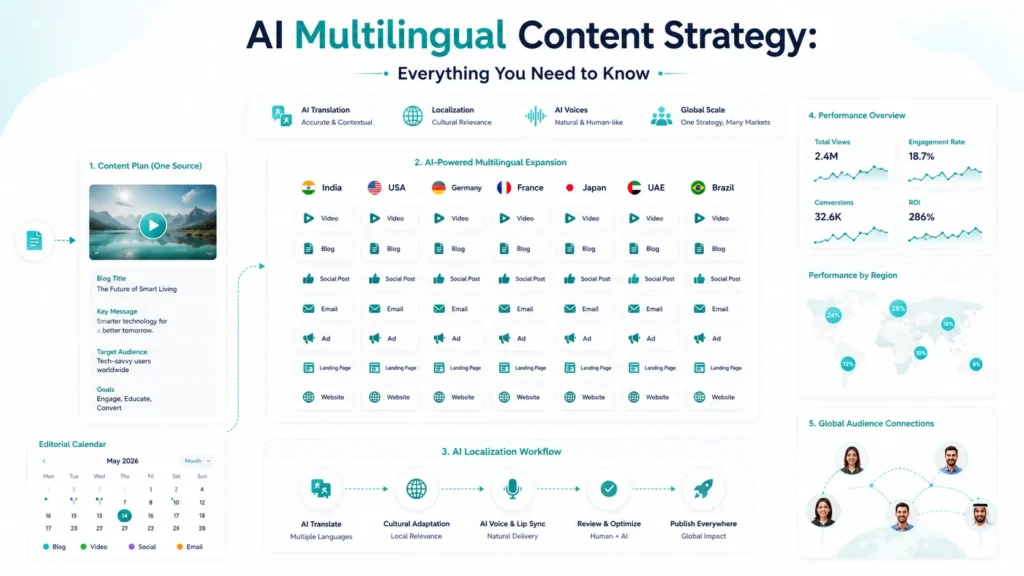
An AI Multilingual Content Strategy is a structured approach to planning, creating, translating, localizing, publishing, and optimizing content across multiple languages using artificial intelligence. Instead of developing separate content strategies for every market, businesses can build one centralized strategy that AI adapts for regional audiences while maintaining consistent brand messaging. This approach helps organizations scale global marketing, improve customer engagement, reduce localization costs, and accelerate international growth.
Key Takeaways
- AI centralizes multilingual content planning across all marketing channels.
- Businesses can localize blogs, videos, websites, emails, advertisements, and social media content faster using AI.
- AI improves brand consistency while adapting messaging for regional audiences.
- Automated translation and localization reduce production costs and time-to-market.
- AI-driven analytics help optimize multilingual content performance continuously.
- A scalable multilingual content strategy enables businesses to reach global customers more efficiently.
Why AI Multilingual Content Strategy Matters
Expanding into international markets requires more than translating existing content. Every audience has unique languages, cultural preferences, buying behaviors, and communication styles.
Traditional multilingual marketing often relies on disconnected teams, manual translation processes, and separate content calendars for each region. These fragmented workflows increase costs, create inconsistencies, and slow campaign execution.
AI Multilingual Content Strategy solves these challenges by creating a unified content planning framework. Artificial intelligence helps businesses organize, localize, distribute, and optimize content from a single source while ensuring every market receives relevant and culturally appropriate messaging.
The result is faster execution, stronger customer engagement, and more consistent global brand communication.
Challenges of Traditional Multilingual Content Management
Many organizations struggle to manage multilingual content at scale because traditional workflows were never designed for today’s global digital landscape.
Common challenges include:
- Maintaining separate content teams for each language.
- High translation and localization costs.
- Inconsistent messaging across regions.
- Delayed campaign launches.
- Duplicate content production efforts.
- Difficulty tracking multilingual content performance.
- Limited scalability as businesses expand into new markets.
These challenges often prevent businesses from delivering a consistent customer experience worldwide.
What Is AI Multilingual Content Strategy?
AI Multilingual Content Strategy is the process of using artificial intelligence to manage the complete lifecycle of multilingual content. Rather than treating translation as the final step, AI integrates language adaptation into the entire content strategy.
This includes:
- Content planning
- AI-assisted content creation
- Translation
- Localization
- Video adaptation
- Social media publishing
- Website management
- Email marketing
- Performance analytics
- Continuous optimization
By connecting these activities into one intelligent workflow, businesses can create a scalable global content ecosystem that supports long-term growth.
Why AI Is Transforming Global Content Strategy
Artificial intelligence has fundamentally changed how businesses approach international marketing. Instead of manually recreating content for every country, AI enables organizations to develop one core message and intelligently adapt it for different languages, cultures, and customer segments.
AI also accelerates repetitive processes such as translation, subtitle generation, content scheduling, localization, SEO optimization, and performance analysis.
This allows marketing teams to spend less time on operational tasks and more time developing creative campaigns that resonate with global audiences.
Introducing the CONNECT™ Framework
Successfully managing multilingual content requires more than powerful AI tools. Businesses need a structured methodology that aligns content planning, localization, distribution, and optimization into a unified strategy.
The CONNECT™ Framework provides a step-by-step roadmap for building scalable multilingual content operations while maintaining brand consistency across every customer touchpoint.
Instead of managing isolated campaigns for different regions, CONNECT™ enables organizations to create one centralized content strategy that AI intelligently adapts for global audiences.
Understanding the CONNECT™ Framework
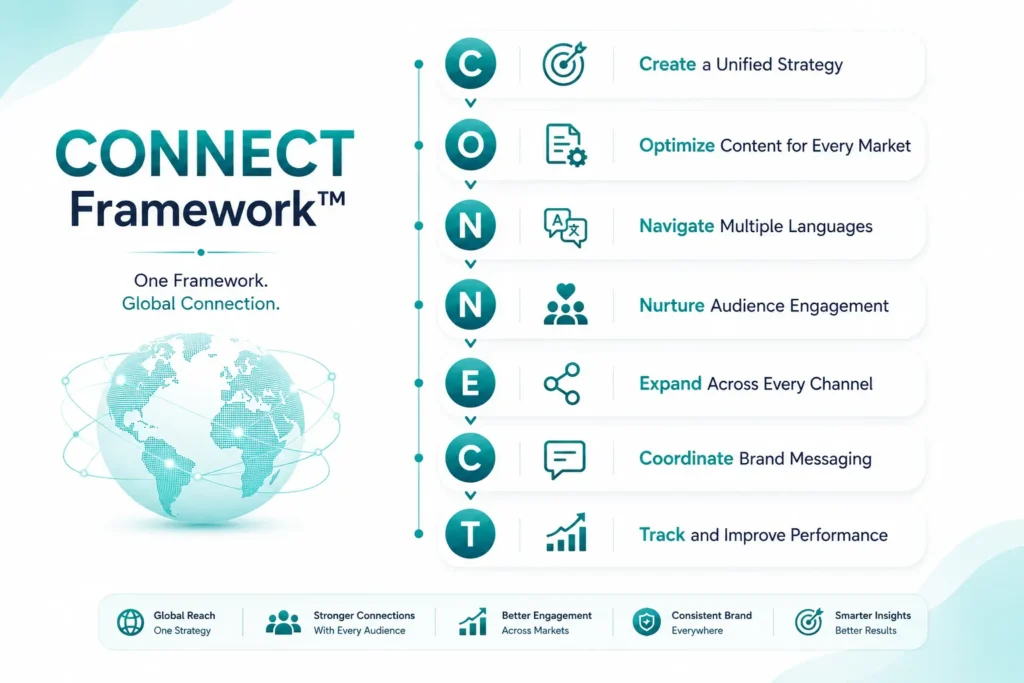
C – Create a Unified Strategy
Every successful multilingual content initiative begins with a centralized content strategy. Instead of creating separate plans for every country, businesses define core messaging, content objectives, brand voice, and publishing priorities that serve as the foundation for all global markets. This unified approach reduces duplication, improves efficiency, and ensures every campaign supports broader business goals.
O – Optimize Content for Every Market
Localization goes far beyond translation. AI helps optimize headlines, visuals, keywords, calls to action, examples, currencies, measurements, and messaging to align with regional expectations while preserving the original intent of the content. This results in more relevant experiences and stronger customer engagement.
N – Navigate Multiple Languages
Managing dozens of languages manually quickly becomes overwhelming. AI simplifies multilingual operations by automating translation, subtitle generation, voice adaptation, terminology management, and language consistency across all content assets. This enables businesses to scale globally without dramatically increasing operational complexity.
N – Nurture Audience Engagement
Different audiences respond to different communication styles and content formats. AI analyzes customer behavior and engagement signals to help marketers personalize messaging, recommend relevant content, and deliver experiences that resonate with each market. Higher relevance leads to stronger customer relationships and improved campaign performance.
E – Expand Across Every Channel
Modern customers interact with brands across websites, blogs, videos, social media, email campaigns, ecommerce stores, and digital advertisements. AI enables businesses to distribute localized content consistently across every channel while maintaining synchronized messaging throughout the customer journey.
C – Coordinate Brand Messaging
As organizations grow internationally, maintaining a consistent brand identity becomes increasingly challenging. AI helps standardize tone, terminology, visual guidelines, and messaging across languages, ensuring customers experience the same brand values regardless of location.
T – Track and Improve Performance
A multilingual content strategy should continuously evolve based on measurable results. AI-powered analytics monitor engagement, conversions, regional performance, content effectiveness, and audience behavior, providing actionable insights that help marketers refine future campaigns and maximize ROI.
Why the CONNECT™ Framework Scales Globally
The CONNECT™ Framework transforms multilingual content management from a collection of disconnected tasks into a unified, AI-driven strategy.
By combining centralized planning, intelligent localization, cross-channel distribution, consistent brand governance, and continuous optimization, businesses can confidently expand into new markets while delivering personalized experiences that strengthen customer trust and drive sustainable global growth.
Read More Articles On AI Video Creation
Real-World Applications of AI Multilingual Content Strategy
An AI Multilingual Content Strategy helps organizations deliver consistent, localized content across multiple languages and customer touchpoints. Instead of creating isolated campaigns for each market, businesses can build one strategic content framework that AI adapts for different regions, languages, and audience preferences.
AI Multilingual Content Strategy for Global Brand Marketing
International brands must communicate consistently across countries while respecting cultural and linguistic differences.
AI enables marketing teams to create one core content strategy and automatically localize blogs, videos, landing pages, advertisements, and social media content for every target market. This approach strengthens brand recognition while reducing operational complexity.
AI Multilingual Content Strategy for E-commerce Content Management
E-commerce businesses publish thousands of product pages, buying guides, promotional campaigns, and customer communications.
An AI Multilingual Content Strategy helps online retailers translate product descriptions, optimize multilingual SEO, localize promotional campaigns, and maintain consistent messaging across international storefronts. Customers receive content that feels native to their language and market, improving trust and increasing conversion rates.
AI Multilingual Content Strategy for SaaS and Technology Companies
Software companies frequently produce product documentation, onboarding materials, release notes, webinars, tutorials, and customer success content.
AI simplifies the localization of technical content, ensuring that users in different countries receive accurate and up-to-date information without delaying product launches.
AI Multilingual Content Strategy for Digital Marketing Agencies
Marketing agencies often manage campaigns for clients operating in multiple regions.
AI allows agencies to create scalable multilingual content workflows that support blogs, email marketing, paid advertising, social media campaigns, and video marketing from a centralized strategy. This improves productivity while delivering consistent results for every client.
AI Multilingual Content Strategy for Enterprise Communication
Large organizations rely on multilingual communication for employees, partners, investors, and customers.
AI helps enterprises manage internal knowledge bases, policy documents, training materials, corporate announcements, and executive communications across multiple languages while maintaining a consistent corporate voice.
AI Multilingual Content Strategy for Education and Online Learning
Educational institutions and online learning platforms create extensive learning resources for students worldwide.
AI enables course providers to localize lessons, learning videos, assessments, and support materials efficiently, making education more accessible to international audiences.
AI Multilingual Content Strategy Across the LovPics Ecosystem
A successful multilingual strategy requires more than content translation. It requires an integrated ecosystem that supports planning, creation, localization, publishing, and performance analysis.
LovPics brings these capabilities together through AI-powered tools that work seamlessly throughout the content lifecycle.
The LovPics ecosystem includes:
- AI Multilingual Videos
- AI Video Translation
- AI Video Dubbing
- AI Lip Sync
- AI Video Localization
- AI Talking Videos
- AI Product Videos
- AI Banner Generation
- AI Social Media Ad Creatives
- AI Brand Kit
- AI Media Manager
- AI Content Workflow
- AI Templates
By combining these solutions, businesses can create one centralized content strategy and distribute localized experiences across websites, videos, social media, digital advertising, email campaigns, and global marketing initiatives.
Common Mistakes Businesses Make
Treating Translation as the Entire Strategy
Translation is only one component of multilingual marketing.
A successful content strategy also includes localization, SEO optimization, audience research, publishing schedules, performance measurement, and continuous improvement.
Creating Separate Content for Every Country
Many organizations duplicate work by building independent content libraries for each market.
AI enables businesses to create a unified content foundation that can be adapted for multiple languages without sacrificing regional relevance.
Ignoring Cultural Context
Content that performs well in one country may not resonate with audiences elsewhere.
AI supports localization by adapting messaging, visuals, calls to action, and terminology to align with local expectations and customer behavior.
Using Inconsistent Brand Messaging
As organizations expand internationally, inconsistent messaging often appears across regions.
A centralized AI strategy helps maintain consistent brand voice, terminology, and visual identity across every language and communication channel.
Measuring Only Translation Speed
Success should not be measured by how quickly content is translated.
Businesses should also monitor customer engagement, organic traffic, lead generation, conversion rates, regional performance, and return on investment to evaluate the effectiveness of their multilingual content strategy.
The Future of AI Multilingual Content Strategy
Artificial intelligence is transforming content strategy from a manual planning process into an intelligent, continuously improving system.
Future AI platforms will automatically recommend content topics, predict audience interests, personalize messaging, optimize multilingual SEO, coordinate publishing across channels, and analyze campaign performance in real time.
Businesses will increasingly rely on AI to build adaptive content ecosystems that respond to customer behavior, market trends, and regional preferences without requiring separate workflows for every language.
Organizations that invest in AI-powered multilingual content strategies today will be better positioned to reach global audiences, improve customer engagement, and scale their marketing operations efficiently.
Comparison Table
Traditional Content Strategy vs AI Multilingual Content Strategy
| Feature | Traditional Strategy | AI Multilingual Content Strategy |
|---|---|---|
| Content Planning | Regional Teams | Centralized AI Planning |
| Translation | Manual | AI Assisted |
| Localization | Separate Workflows | Automated |
| Brand Consistency | Difficult | Centralized |
| Content Distribution | Manual Publishing | Multi-channel Automation |
| Performance Tracking | Limited | AI Analytics |
| Scalability | Moderate | High |
| Global Expansion | Slow | Fast |
Decision Matrix
Who Should Use AI Multilingual Content Strategy?
| Organization | Recommendation |
|---|---|
| Global Enterprises | ⭐⭐⭐⭐⭐ |
| E-commerce Businesses | ⭐⭐⭐⭐⭐ |
| SaaS Companies | ⭐⭐⭐⭐⭐ |
| Digital Marketing Agencies | ⭐⭐⭐⭐⭐ |
| Educational Platforms | ⭐⭐⭐⭐☆ |
| Healthcare Organizations | ⭐⭐⭐⭐☆ |
| Financial Institutions | ⭐⭐⭐⭐☆ |
| Travel and Hospitality | ⭐⭐⭐⭐☆ |
| Manufacturing Companies | ⭐⭐⭐⭐☆ |
| Media and Publishing Companies | ⭐⭐⭐⭐⭐ |
Frequently Asked Questions
What is an AI Multilingual Content Strategy?
An AI Multilingual Content Strategy is a structured approach that uses artificial intelligence to plan, create, localize, publish, and optimize content across multiple languages while maintaining consistent brand messaging and improving operational efficiency.
How is multilingual content strategy different from translation?
Translation converts content from one language to another. A multilingual content strategy includes planning, localization, SEO, content distribution, audience targeting, analytics, and ongoing optimization to support long-term global growth.
Can AI improve multilingual SEO?
Yes. AI helps optimize multilingual keywords, metadata, headings, internal links, and localized content, making it easier for businesses to improve search visibility across different languages and regions.
Which businesses benefit the most from AI Multilingual Content Strategy?
Global brands, ecommerce companies, SaaS businesses, marketing agencies, educational institutions, enterprises, and organizations with international audiences benefit significantly from implementing AI-powered multilingual content strategies.
Why should businesses choose LovPics?
LovPics combines AI Multilingual Videos, AI Video Translation, AI Video Dubbing, AI Lip Sync, AI Video Localization, AI Content Workflow, AI Banner Generation, AI Templates, AI Media Manager, and AI-powered marketing tools into one platform. This integrated ecosystem enables businesses to create, localize, manage, and scale multilingual content efficiently while maintaining a consistent global brand presence.
Conclusion
Expanding into international markets requires more than translating content into different languages. Businesses need a comprehensive strategy that connects planning, localization, publishing, optimization, and performance measurement into one unified workflow.
An AI Multilingual Content Strategy provides that foundation by helping organizations create content once, adapt it intelligently for global audiences, and distribute it consistently across every digital channel.
Using the CONNECT™ Framework, businesses can centralize their multilingual content operations, strengthen brand consistency, improve customer engagement, and scale international marketing with greater speed and efficiency. When combined with the AI-powered ecosystem of LovPics, organizations gain the tools needed to build sustainable multilingual content strategies that support long-term global growth.