AI vs Product Photography: Which Is Better for Ecommerce?

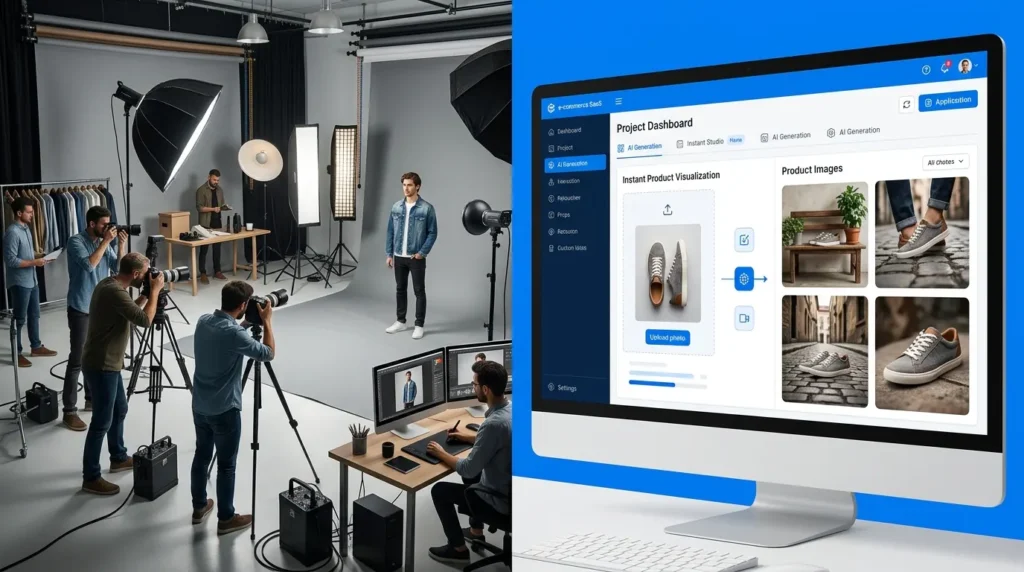
AI Product Photography enables ecommerce businesses to create professional product images faster and at a lower cost than traditional photography. It is ideal for scaling catalogs, producing marketing assets, and launching products quickly. Traditional product photography still plays an important role for premium brand campaigns, luxury editorials, and highly customized creative shoots. For most ecommerce brands, the most effective approach is combining AI with traditional photography to maximize quality, speed, and scalability.
Key Takeaways
- AI Product Photography dramatically reduces production costs and turnaround time.
- Traditional photography remains valuable for premium branding and editorial campaigns.
- AI helps brands scale product catalogs without increasing photography resources.
- Hybrid workflows provide the best balance between creativity and efficiency.
- Modern ecommerce brands increasingly rely on AI for everyday content production while reserving traditional photography for flagship campaigns.
Why Ecommerce Brands Are Reconsidering Product Photography
Product photography has always been one of the largest investments for ecommerce businesses. Every product launch requires professional images that help customers understand quality, appearance, size, and important product details before making a purchase.
For years, the process was straightforward. Brands hired photographers, booked studios, arranged lighting equipment, prepared products, and spent days editing photographs before publishing them online.
That approach still produces excellent results.
However, ecommerce has changed dramatically.
Modern businesses launch products more frequently, sell across multiple marketplaces, create advertising campaigns continuously, and manage significantly larger product catalogs than ever before. Producing thousands of images using only traditional photography has become expensive, time-consuming, and difficult to scale.
Artificial intelligence is changing this workflow by allowing businesses to create professional product images in minutes rather than weeks.
Why Traditional Product Photography Is Becoming Harder to Scale
Traditional product photography remains the benchmark for creative quality, but scaling it presents several operational challenges.
Every photoshoot involves scheduling photographers, booking studios, arranging lighting equipment, preparing products, organizing props, hiring models when required, and completing extensive post-production editing.
For brands introducing hundreds of new products every season, repeating this process becomes increasingly expensive.
Even relatively small updates can require additional studio sessions.
Examples include:
- New product colors
- Seasonal campaigns
- Marketplace images
- Promotional banners
- Holiday collections
- Localized marketing
Every variation adds more production time.
As product catalogs continue expanding, photography often becomes one of the biggest bottlenecks in ecommerce operations.
What Is AI Product Photography?
AI Product Photography uses artificial intelligence to generate professional-quality product images without the need for traditional studio production.
Instead of photographing each variation individually, businesses upload a product image and let AI generate multiple professionally styled images.
These may include:
- White background product images
- Lifestyle photography
- Marketing creatives
- Marketplace images
- Social media visuals
- Promotional banners
- Product detail images
- Seasonal campaign assets
Rather than replacing creative professionals, AI automates repetitive production tasks that traditionally consume significant time and resources.
AI vs Traditional Product Photography
Both approaches have clear advantages depending on business goals.
Traditional photography offers maximum creative control. Photographers can carefully adjust lighting, styling, composition, props, and storytelling to create unique brand experiences. This makes traditional photography ideal for luxury campaigns, premium product launches, and editorial content.
AI Product Photography focuses on efficiency. It rapidly generates consistent product visuals that are suitable for ecommerce websites, marketplaces, advertisements, and social media. Businesses can create hundreds of image variations without organizing repeated studio sessions.
For brands managing growing product catalogs, AI significantly reduces production costs while accelerating product launches.
Introducing the SMART Framework™
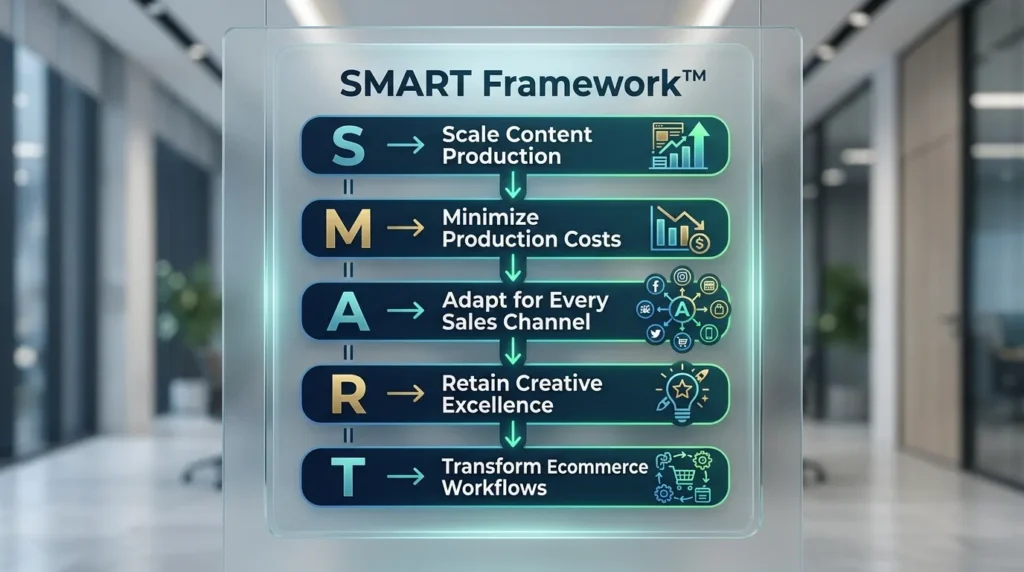
At LovPics, we believe the discussion should not focus on replacing photographers. Instead, successful ecommerce brands build SMART content production workflows that combine creative expertise with AI automation.
S – Scale Content Production
Generate hundreds of professional product images without increasing photography resources or extending production timelines.
M – Minimize Operational Costs
Reduce expenses associated with studios, equipment, model bookings, logistics, and repetitive editing while maintaining professional quality.
A – Adapt to Every Sales Channel
Create optimized visuals for ecommerce websites, Amazon, Shopify, social media, advertising campaigns, email marketing, and marketplaces from a unified workflow.
R – Retain Creative Excellence
Continue using professional photographers where creativity delivers the greatest business value, including hero campaigns, brand storytelling, and premium launches.
T – Transform the Entire Workflow
Combine AI Product Photography with traditional photography to create a scalable production system that supports long-term ecommerce growth instead of isolated photoshoots.
When AI Product Photography Is the Better Choice
AI Product Photography performs exceptionally well when businesses need speed, consistency, and scalability.
Common use cases include:
- Large ecommerce catalogs
- Marketplace product images
- Product launches
- Seasonal promotions
- Social media content
- Advertising creatives
- Product color variations
- Background replacements
- Catalog updates
- International marketing campaigns
Instead of waiting days for new photography, businesses can generate fresh visual content almost immediately.
When Traditional Product Photography Still Wins
Although AI has transformed ecommerce content creation, traditional photography remains valuable in several situations.
Luxury fashion campaigns often require artistic direction that extends beyond product presentation.
Editorial magazines rely on creative storytelling.
Premium branding projects may involve complex lighting, custom-built sets, celebrity models, or unique visual concepts that demand complete creative control.
Traditional photography also remains important when brands want exclusive hero images that define long-term brand identity.
Rather than competing against AI, these creative projects complement AI-powered ecommerce production.
Real World Comparison: AI Product Photography vs Traditional Photography
The decision between AI Product Photography and traditional photography is not always about choosing one over the other. Instead, it depends on the type of content you need, your production volume, your budget, and your business goals. Understanding where each approach performs best helps ecommerce brands build a more efficient content production strategy.
Product Catalog Photography
Modern ecommerce stores often manage hundreds or thousands of products. Photographing every item in a studio requires significant planning, scheduling, editing, and logistics. AI Product Photography allows brands to create consistent product images for entire catalogs in a fraction of the time, making it the preferred choice for high-volume ecommerce operations.
Read More Articles on AI Product Photography
Marketing Campaigns
Marketing teams constantly require fresh visuals for advertisements, email campaigns, landing pages, and seasonal promotions. Traditional photography can deliver exceptional creative quality, but producing new assets for every campaign quickly becomes expensive. AI Product Photography enables marketers to generate multiple campaign-ready images rapidly, allowing brands to react to trends and promotions much faster.
Marketplace Listings
Platforms such as Amazon, Flipkart, Etsy, and other online marketplaces have specific image requirements. Sellers often need multiple product images, white background photos, close-up shots, and promotional visuals for every listing. AI Product Photography simplifies this process by generating marketplace-ready images while maintaining consistent product presentation.
Social Media Content
Social media platforms demand continuous visual content. Creating new photoshoots for every post is neither practical nor cost-effective. AI Product Photography helps brands produce engaging product visuals for Instagram, Facebook, Pinterest, LinkedIn, and other platforms while keeping branding consistent across all channels.
Premium Brand Campaigns
Luxury brands and premium product launches still benefit from traditional photography. Creative directors often require complete artistic control over lighting, locations, styling, props, and storytelling. These high-impact campaigns create emotional connections that remain difficult to replicate entirely through automation.
Why Hybrid Workflows Deliver the Best Results
Many successful ecommerce businesses no longer view AI and traditional photography as competing approaches. Instead, they combine both to create faster, more scalable production workflows.
A typical hybrid workflow looks like this:
- Use traditional photography for flagship campaigns and brand storytelling.
- Capture hero product images professionally.
- Use AI Product Photography to generate variations, marketing creatives, marketplace assets, and seasonal content.
- Produce localized visuals for different regions without organizing additional photoshoots.
- Scale product catalogs while maintaining visual consistency.
This approach allows creative teams to focus on high-value work while AI handles repetitive production tasks.
AI Product Photography Across the Ecommerce Workflow
The greatest advantage of AI Product Photography is its ability to integrate with a complete ecommerce content ecosystem rather than functioning as a standalone image generator.
AI Product Photography works seamlessly with:
- AI Productshoot
- AI Fashion Studio
- AI Fashion Models
- AI Virtual Try-On
- AI Product Design
- AI Background Generator
- E-commerce Image Packs
- E-commerce Shoot Packs
- Bulk Image Export
- Reusable Templates
- 360° Product Views
Together, these features help businesses move from a single product image to a complete library of e-commerce-ready marketing assets with minimal manual effort.
Common Mistakes Businesses Make
Assuming AI Completely Replaces Photographers
Artificial intelligence is designed to automate repetitive production work rather than eliminate creative professionals. Photographers continue to play an important role in premium campaigns, brand storytelling, and high-end editorial projects.
Using Traditional Photography for Every Asset
Many businesses still organize studio sessions for every marketing requirement, even when AI could efficiently generate product variations, promotional images, or marketplace assets. This increases production costs without adding significant business value.
Ignoring Content Scalability
Product catalogs continue growing every year. Businesses that rely only on traditional photography often struggle to keep pace with new launches, promotional campaigns, and regional marketing needs. AI Product Photography enables brands to scale visual production without proportionally increasing resources.
Inconsistent Visual Branding
Using different photographers, lighting setups, editing styles, or production teams can create inconsistent product catalogs. AI helps maintain a standardized visual identity across thousands of images, strengthening overall brand recognition.
The Future of Ecommerce Product Photography
Artificial intelligence is transforming ecommerce photography from a project-based activity into a continuous content production system. Instead of organizing separate photoshoots whenever new products launch, businesses can generate professional visuals whenever they are needed.
Future ecommerce brands will not choose between AI and traditional photography. They will combine both approaches strategically.
Traditional photography will continue creating memorable brand experiences, while AI Product Photography will power catalog production, marketplace content, product updates, advertising creatives, and international marketing at scale.
Businesses adopting this balanced approach will launch products faster, reduce production costs, respond more quickly to market changes, and maintain consistent visual quality across every customer touchpoint.
Frequently Asked Questions
Do I still need a product photographer?
It depends on your business goals. Traditional photographers remain valuable for premium campaigns, creative storytelling, and luxury branding. For everyday ecommerce product images, AI Product Photography can significantly reduce the need for repeated studio sessions.
Is AI Product Photography better than traditional Product Photography?
Neither approach is universally better. AI Product Photography excels in speed, scalability, and cost efficiency, while traditional photography offers greater creative control for high-end campaigns. Most ecommerce businesses benefit from using both strategically.
Can AI replace product photographers?
AI can automate many repetitive product photography tasks, including creating catalog images, marketplace assets, and marketing visuals. However, professional photographers remain essential for creative direction, editorial campaigns, and premium brand experiences.
Is AI Product Photography suitable for ecommerce?
Yes. AI Product Photography is specifically designed for ecommerce businesses that require professional product images for websites, marketplaces, social media, advertising campaigns, and product catalogs.
Which businesses benefit from AI Product Photography?
Fashion brands, ecommerce stores, Shopify merchants, Amazon sellers, D2C businesses, agencies, and marketplace sellers all benefit from AI Product Photography because it accelerates content production while reducing costs.
Is AI Product Photography cheaper?
Yes. Compared to repeated studio photoshoots, AI Product Photography significantly lowers production costs by reducing the need for photographers, studios, models, logistics, and extensive editing.
Can AI generate marketplace-ready product images?
Yes. AI Product Photography can create images optimized for marketplaces, ecommerce websites, advertising platforms, and social media while maintaining consistent quality and branding.
What is the best AI Product Photography platform?
LovPics provides a complete AI Product Photography workflow that includes AI Product Photos, AI Fashion Studio, AI Virtual Try-On, AI Product Design, E-commerce Image Packs, E-commerce Shoot Packs, Bulk Image Export, and other tools that help businesses create scalable ecommerce visual content efficiently.
Conclusion
The debate between AI Product Photography and traditional photography is no longer about choosing one over the other. Modern ecommerce businesses achieve the best results by combining both approaches into a unified content production strategy.
Traditional photography continues to deliver exceptional creative work for premium campaigns, while AI Product Photography provides the speed, consistency, and scalability required for everyday ecommerce operations. Together, they enable brands to build richer product catalogs, launch campaigns faster, reduce production costs, and maintain professional visual standards across every sales channel.
As ecommerce continues to evolve, businesses that embrace AI as a creative partner rather than a replacement will be better positioned to scale efficiently, respond to changing market demands, and deliver outstanding shopping experiences that drive long-term growth.